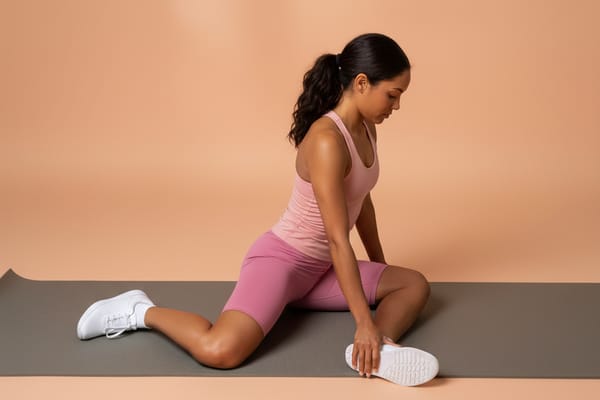
The 90/90 hip stretch is a seated position where both knees bend to about 90 degrees, one leg in front of you and one to the side. The front hip stretches into external rotation and the back hip into internal rotation. Sit tall, lean forward over the front shin, and hold 30 to 60 seconds per side.
Most hip stretches work one direction at a time. The 90/90 hip stretch works two. With one leg turned out in front of you and the other turned in behind you, both hips rotate in opposite directions at once. That is why coaches and physical therapists use it so often as a test and as a stretch.
The name comes from the shape of the legs. Both knees bend to roughly 90 degrees, and each thigh sits at roughly 90 degrees to the other. It looks simple on paper. In practice, many people find that one side feels easy and the other feels locked, or that they cannot sit upright without falling backward.
This guide covers what the 90/90 hip stretch targets, how to set it up correctly, the most common mistakes, and how to progress from a supported version to active hip switches.
What the 90/90 Hip Stretch Targets
The hip is a ball-and-socket joint. It can rotate outward (external rotation) and inward (internal rotation). Daily life gives most people very little practice at either end of that range, especially internal rotation.
Front leg (external rotation): The front hip turns out. When you lean forward over the front shin, you stretch the glutes and the deep hip rotators, including the piriformis. This part feels similar to pigeon pose.
Back leg (internal rotation): The back hip turns in. This stretches the muscles that turn the hip out, such as the gluteus medius and parts of the gluteus maximus, and asks the hip joint to move into a range many people rarely use.
Groin and hip capsule: Depending on how you lean, you may also feel a stretch along the inner thigh of the front leg and around the front of the back hip.
Reduced hip internal rotation is common and is linked to some hip problems. A screening study of 270 youth ice hockey and ringette players found that male athletes with hip-related groin pain had less hip internal rotation, flexion and adduction than those without pain.1 That type of study shows an association, not a cause, but it explains why hip rotation work is a regular part of many athletes’ programs.
How to Do the 90/90 Hip Stretch
Step-by-Step Setup
- Sit on the floor with your knees bent and your feet flat, a little wider than hip width.
- Let both knees fall to the right. Your right leg is now in front of you, turned out. Your left leg is beside you, turned in.
- Adjust the front leg so the shin runs across the front of your body and the knee bends to about 90 degrees.
- Adjust the back leg so the thigh points out to the side and the knee bends to about 90 degrees, with the foot behind you.
- Sit up tall. Try to keep both sitting bones close to the floor, even if one side lifts a little at first.
- Place your fingertips on the floor beside your hips for support.
The Front-Leg Stretch
- Turn your chest to face your front shin.
- Keep your spine long and hinge forward from the hips, as if you want to bring your belly button toward your shin.
- Stop when you feel a clear stretch in the outer hip and glute of the front leg.
- Hold for 30 to 60 seconds, breathing slowly.
The Back-Leg Stretch
- Return to upright.
- Turn your chest toward the back knee.
- Gently lean toward the back thigh, or press your back knee and foot lightly into the floor.
- You should feel the stretch in the outer hip and front of the hip on the back leg. Hold for 30 to 60 seconds.
Then lift your knees through the center and repeat everything on the other side.
Breathing and Cues
- Lead with your chest, not your head. Rounding forward from the upper back shortens the stretch.
- Keep both shins relaxed and your feet soft.
- On each exhale, let the hip you are stretching sink a little closer to the floor.
- Aim for a strong stretch you could hold while talking calmly, not a pain you need to brace against.
How Long to Hold
Hold each position for 30 to 60 seconds. If you want to improve range, two rounds per side is a good starting dose. A review of long-term stretching studies found that static stretching on at least 5 days per week, adding up to at least 5 minutes per week for a muscle group, was linked to better range of motion gains.2 The 90/90 is easy to repeat often because you only need a floor.
Common Mistakes
Falling Backward
If you cannot sit upright, your weight will drift back and your lower back will round. The stretch on the hips becomes weak.
Fix: Sit on a folded blanket or yoga block so your hips are higher than your knees. Or use the leaning 90/90 described below.
Lifting the Back Hip
The back-leg sitting bone often lifts high off the floor. A little lift is normal, especially at the start. A big lift means you are skipping the internal rotation.
Fix: Move the back foot closer to your body so the back knee bends more than 90 degrees. This makes internal rotation easier and lets the hip settle.
Rounding the Spine to Go Lower
Collapsing over the front shin feels like a deeper stretch but moves the work into your upper back.
Fix: Keep your chest open and your spine long. A smaller lean with a straight back stretches the hip more.
Forcing the Knees to 90 Degrees
The 90-degree angles are a target, not a rule. Forcing the shape can twist the knee, which does not rotate the way the hip does.
Fix: Let the knees bend more if they need to. If you feel pain inside the knee, reduce the angle and keep the feet relaxed.
Holding the Breath
Many people hold their breath when a stretch feels intense. This keeps the muscles tense.
Fix: Breathe slowly and longer on the exhale. If you cannot breathe calmly, back off.
Easier Variations
Leaning 90/90
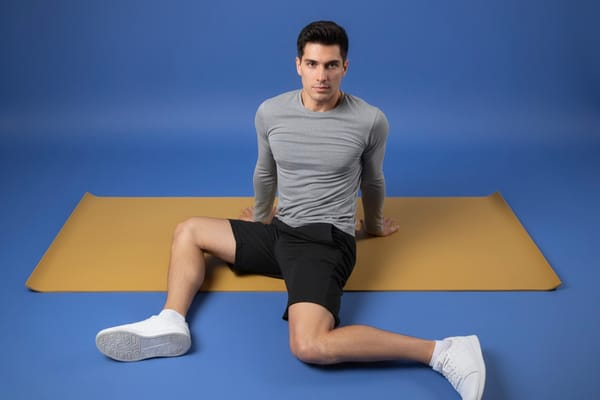
Place your hands on the floor behind you and lean back. Keep your chest lifted and your shoulders over your hands. This takes most of the weight off the hips and lets you focus on the rotation without fighting to stay upright.
Elevated Hips
Sit on a cushion, folded blanket or yoga block. Raising the hips reduces the amount of rotation required and makes the upright position much easier.
Seated Figure Four
If your knees do not tolerate the 90/90 shape, sit on a chair and cross one ankle over the opposite thigh. Hinge forward with a long spine. This targets the same external rotators as the front leg of the 90/90, without loading the back hip or either knee on the floor.
Harder Variations
90/90 Hip Switch
This turns the stretch into an active mobility drill.
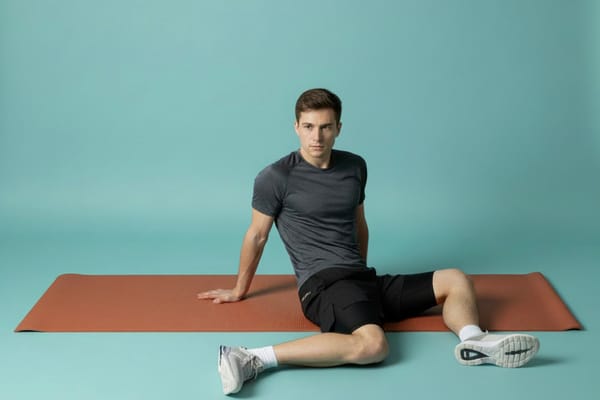
- Sit with your feet planted, a little wider than hip width, hands on the floor behind you.
- Let both knees fall to one side into the 90/90 position.
- Lift your knees through the center and lower them to the other side.
- Move slowly, about 2 to 3 seconds each way. Do 8 to 10 switches per side.
Hands-Free Hip Switch
Do the same switch with your arms held in front of your chest. Without your hands for support, your core and hip muscles have to control the movement. If your torso tips back, return to the supported version for a few weeks.
90/90 Hip Lift
From the 90/90 position, drive through the front shin and squeeze the glute of the back leg to lift your hips off the floor. Pause briefly, lower with control, then switch sides. This builds strength at the end of your rotation range, which helps new flexibility stay.
Front-Leg Lift-Off
Sit upright in 90/90 without hands. Try to lift the front foot an inch off the floor while keeping the knee down. Then try the same with the back foot. These are small movements, but they are hard. They train the muscles that hold the hip in rotation.
How to Use the 90/90 in a Routine
As a Warm-Up
Use the dynamic hip switch for 1 to 2 minutes before squats, deadlifts, running or field sports. A systematic review of stretching before activity found that dynamic stretching produced small to moderate performance improvements when done shortly before activity, while long static holds immediately before exercise could reduce performance a little.3 Save long 90/90 holds for after training.
As a Cool-Down or Mobility Session
After training, hold each side for 45 to 60 seconds and add the back-leg stretch. Combine with pigeon pose, a groin stretch and a hip flexor stretch for a full hip session. The Hip Opening 90/90 Flow routine follows this structure.
For Desk Workers
Long hours of sitting keep the hips in one position. A short floor session of 90/90 switches in the evening gives the hips a range they rarely get during the day. Pair it with the ideas in our stretching for desk workers guide.
Sample 6-Minute Sequence
- 90/90 hip switches with hands: 10 switches
- Front-leg 90/90 stretch: 45 seconds per side
- Back-leg 90/90 stretch: 45 seconds per side
- Hands-free hip switches: 8 switches
- 90/90 hip lift: 5 per side
If you want to work more on the deep rotators, the Hip Opening Rotators routine adds figure four and pigeon variations. For a strength focus, the Hip Stability Starter routine builds control around the joint.
90/90 and Back Pain
Hip mobility and back pain are often discussed together. The evidence suggests a link, but a modest one. A meta-analysis of 40 trials on trunk-focused exercise programs for chronic non-specific low back pain found that greater gains in trunk or hip range of motion were associated with greater reductions in pain and disability.4 That does not prove the 90/90 helps back pain on its own, but hip rotation work is a reasonable part of a broader program. Our lower back pain stretching guide covers that wider picture.
Who Should Be Careful
Knee problems: The 90/90 places a twisting load on the knees, especially the back knee. If you have a meniscus injury, ligament injury or knee pain, use the leaning version, sit on a block, or switch to the seated figure four. Our stretches for knee pain article has more knee-friendly options.
Hip impingement or labral tears: Deep rotation can pinch the front of the hip. If you feel a sharp pinch rather than a stretch, back off. Elevating your hips often helps.
Hip replacement: Many hip replacement protocols restrict combined flexion and internal rotation for a period after surgery. Do not use the 90/90 until your surgeon or physical therapist clears you.
Pregnancy: The 90/90 is often comfortable in pregnancy, but ligaments may be more lax. Keep the stretch gentle and avoid forcing range.
When to See a Professional
See a doctor or physical therapist if you have:
- Sharp or catching pain in the hip or groin during rotation
- Clicking or locking in the hip together with pain
- Knee pain that continues after you stop stretching
- One hip that stays much more restricted than the other over several weeks of regular practice
Key Takeaways
- The 90/90 trains external rotation in the front hip and internal rotation in the back hip at the same time
- Sit tall and lean from the hips, not from the upper back
- Hold 30 to 60 seconds per side, and stretch most days for lasting change
- Use a block or the leaning version if you fall backward or your back hip lifts high
- Progress to hip switches and lifts to add control and strength to your new range
Frequently Asked Questions
What does the 90/90 hip stretch do?
The 90/90 hip stretch moves both hips into rotation at once. The front hip turns out and stretches the glutes and deep rotators, while the back hip turns in and works on internal rotation. Many people use it to improve hip mobility for squatting, running and sitting on the floor, and to find side-to-side differences.
Why is the 90/90 stretch so hard for me?
Most people rarely use full hip internal rotation in daily life, so the back leg often feels stuck. Tight glutes and rotators can also make it hard to sit upright. Sit on a folded blanket or block, use the leaning version with your hands behind you, and let your knees bend more than 90 degrees at first.
How long should I hold the 90/90 hip stretch?
Hold each position for 30 to 60 seconds and do two rounds per side if you want to improve range. Before training, use dynamic hip switches instead of long holds, about 8 to 10 switches per side. Long static holds work best after training or in a separate evening mobility session.
Is the 90/90 stretch bad for your knees?
It is safe for most healthy knees when done gently, but it does place some twisting load on them, mainly on the back knee. If you feel pain inside the knee, let the knee bend more, elevate your hips, or choose a seated figure four instead. People with meniscus or ligament injuries should ask a physical therapist first.
Related Articles
References
Martin M, Soligon C, Galarneau JM, et al. (2026). Evaluating the Prevalence of Signs and Symptoms Associated With Hip-Related Groin Pain in Youth Ice Hockey and Ringette, Part 1: A Reliability and Cross-Sectional Study. Clinical Journal of Sport Medicine, 36(5), 595-604. PubMed ↩︎
Thomas E, Bianco A, Paoli A, Palma A. (2018). The Relation Between Stretching Typology and Stretching Duration: The Effects on Range of Motion. International Journal of Sports Medicine, 39(4), 243-254. PubMed ↩︎
Behm DG, Blazevich AJ, Kay AD, McHugh M. (2016). Acute effects of muscle stretching on physical performance, range of motion, and injury incidence in healthy active individuals: a systematic review. Applied Physiology, Nutrition, and Metabolism, 41(1), 1-11. PubMed ↩︎
Prat-Luri A, de Los Rios-Calonge J, Moreno-Navarro P, Manresa-Rocamora A, Vera-Garcia FJ, Barbado D. (2023). Effect of Trunk-Focused Exercises on Pain, Disability, Quality of Life, and Trunk Physical Fitness in Low Back Pain and How Potential Effect Modifiers Modulate Their Effects: A Systematic Review With Meta-analyses. Journal of Orthopaedic & Sports Physical Therapy, 53(2), 64-93. PubMed ↩︎
