Tight chest muscles are one of the most overlooked causes of poor posture, shoulder pain, and restricted upper body movement. Hours of typing, driving, and scrolling train your pectorals to stay shortened, pulling your shoulders forward into the rounded position that has become the default for modern life.
The numbers are striking. Research shows that 55 to 69% of computer users experience neck pain and 15 to 52% develop shoulder pain, with tight pectorals identified as a key contributor to this pattern known as upper crossed syndrome.1 Yet while most people stretch their hamstrings and hips, the chest rarely gets the same attention.
This guide explains why your chest gets tight, which stretches actually work (and what the research says about them), and how to build a routine that opens up your front body for good.
Why Your Chest Gets Tight
The Desk Worker’s Posture
When you sit at a desk, your arms reach forward, your shoulders roll inward, and your pectoralis major and minor gradually shorten. This is not just a positioning problem. Over time, the nervous system adapts to treat this shortened length as the new baseline.
A meta-analysis of 22 studies found that this pattern, often called upper crossed syndrome, involves tight pectorals and upper traps crossed with weak deep neck flexors and lower trapezius.2 The muscle imbalance creates a self-reinforcing cycle: tight chest muscles pull the shoulders forward, which weakens the upper back muscles, which allows the chest to tighten further.
Training Imbalances
Push-heavy training programs (bench press, push-ups, shoulder press) without matching pulling volume make chest tightness worse. The pectorals become strong in their shortened range while the opposing muscles of the upper back cannot counterbalance the pull.
Stress and Breathing Patterns
Shallow chest breathing, which is common during stress, overuses the accessory breathing muscles including the pectoralis minor. Chronic stress keeps these muscles in a partially contracted state, contributing to that persistent feeling of chest and shoulder tightness.
Signs Your Chest Needs Stretching
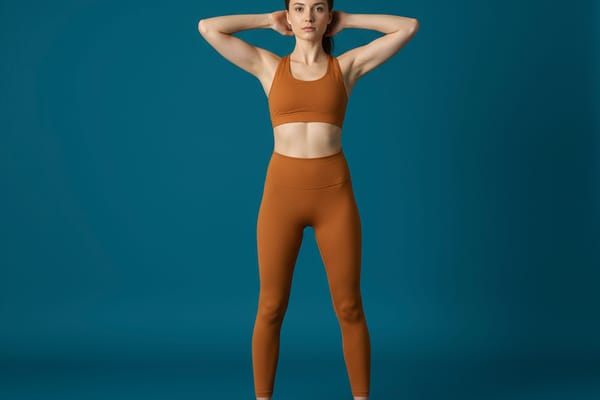
- Shoulders that roll forward at rest: Stand sideways in front of a mirror. If your hands hang in front of your thighs rather than at your sides, your pectorals are likely short
- Difficulty clasping hands behind your back: Limited ability to bring your arms behind you suggests restricted pectoral and anterior shoulder flexibility
- Upper back pain between the shoulder blades: Tight chest muscles force the upper back muscles to work overtime, creating tension and pain in the mid-back
- Shoulder impingement symptoms: A shortened pectoralis minor tilts the scapula forward, narrowing the subacromial space and increasing the risk of impingement
- Rounded upper back (kyphosis): Chronic chest tightness pulls the thoracic spine into excessive flexion over time
The Best Chest Stretches
Doorway Pecs
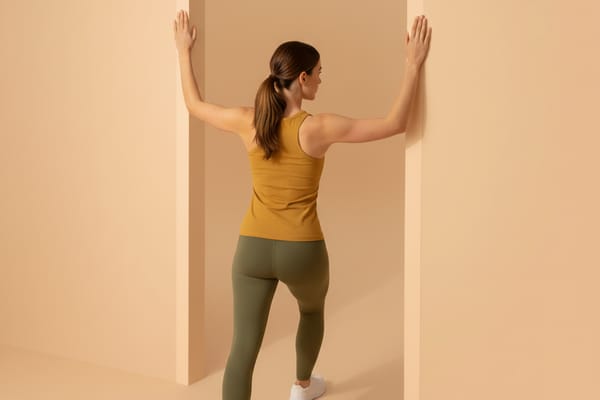
The doorway stretch is one of the most effective chest stretches because the doorframe provides a stable anchor point that allows you to control the stretch depth precisely. It targets the pectoralis major and anterior deltoid.
How to do it:
- Stand in a doorway with one arm bent at 90 degrees, forearm resting against the frame
- Step forward with the foot on the same side as the stretched arm
- Rotate your torso gently away from the arm until you feel a stretch across the front of your chest
- Hold for 30 to 60 seconds, then switch sides
Tip: Changing your elbow height changes which fibers get stretched. Elbow at shoulder height targets the middle chest fibers. Elbow above shoulder height targets the lower pec fibers. Elbow below shoulder height targets the upper chest and clavicular fibers.
Wall Pecs
Similar to the doorway stretch but using a flat wall, this variation works well when a doorway is not available. It provides a gentler stretch that is good for beginners or people with shoulder sensitivity.
How to do it:
- Stand next to a wall with your arm extended and palm flat against the surface at shoulder height
- Slowly turn your body away from the wall
- Stop when you feel a comfortable stretch across your chest
- Hold for 30 to 60 seconds, then switch sides
Adjustments: If shoulder pain occurs, lower your hand position on the wall or reduce how far you rotate.
Chest Opener
The chest opener is a simple standing stretch that opens the entire front body. It is gentle enough to do multiple times throughout the day and works well as a quick posture reset during desk work.
How to do it:
- Stand tall with your feet hip-width apart
- Clasp your hands behind your lower back
- Straighten your arms and gently lift your hands away from your body
- Squeeze your shoulder blades together and lift your chest
- Hold for 30 seconds
Tip: Focus on the squeeze between your shoulder blades rather than forcing your hands higher. The stretch should come from opening the chest, not straining the shoulders.
Cactus Arms
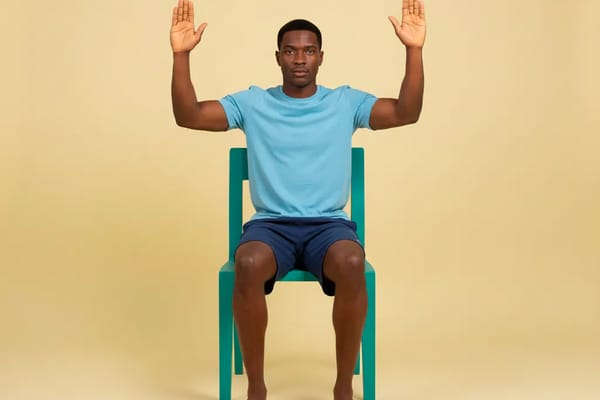
Cactus arms combine a chest stretch with scapular retraction, making it one of the best exercises for counteracting the forward-shoulder pattern. It activates the upper back muscles while stretching the pectorals.
How to do it:
- Stand or sit tall with your arms raised to shoulder height, elbows bent at 90 degrees (like a goalpost)
- Squeeze your shoulder blades together, drawing your elbows back
- Hold the squeezed position for 5 seconds
- Release and repeat 8 to 10 times
- On the final rep, hold the position for 30 seconds
Seated Chest Stretch
This floor-based stretch provides a deep pectoral opening with the added benefit of gravity assistance. It works particularly well at the end of a stretching session when you are already warm.

How to do it:
- Sit on the floor with your legs in a comfortable position
- Place your hands on the floor behind you, fingers pointing away from your body
- Walk your hands back until you feel a stretch across the front of your chest
- Press your chest forward and up
- Hold for 30 to 60 seconds
Upward Dog
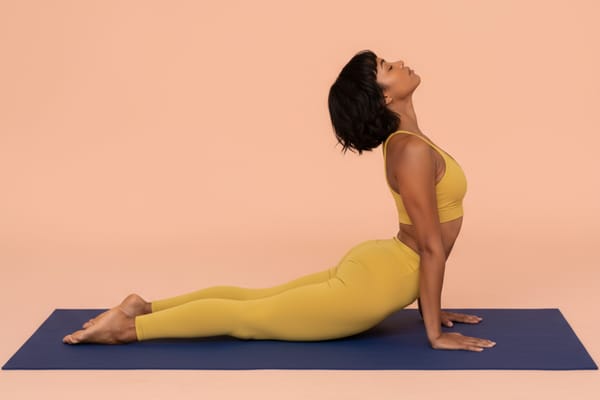
Upward dog stretches the entire front body including the chest, abdomen, and hip flexors. It is a more active stretch that also strengthens the upper back.
How to do it:
- Lie face down with your hands under your shoulders
- Press through your hands to lift your chest off the ground
- Straighten your arms, keeping your shoulders down and away from your ears
- Lift your thighs off the ground by pressing through the tops of your feet
- Hold for 15 to 30 seconds
Adjustments: If this is too intense for your lower back, keep your forearms on the ground (cobra pose) instead of straightening your arms fully.
Camel Pose
Camel pose is an intermediate backbend that provides a deep stretch for the chest, shoulders, and hip flexors. It requires some baseline flexibility and is best done after warming up with gentler stretches.
How to do it:
- Kneel on the floor with your knees hip-width apart
- Place your hands on your lower back, fingers pointing down
- Lift your chest toward the ceiling, arching your upper back
- If comfortable, reach back to place your hands on your heels
- Hold for 15 to 30 seconds
Adjustments: Keep your hands on your lower back if reaching for your heels feels too intense. Tuck your toes under to raise your heels and make them easier to reach.
What the Research Says About Chest Stretching
The science behind chest stretching is surprisingly specific. A study measuring pectoralis minor stiffness using shear wave elastography found that muscle stiffness decreased significantly after just 30 seconds of stretching, with greater reductions after 90 seconds total.3 This tells us that even brief stretching sessions produce real tissue-level changes.
An 8-week RCT comparing pectoral stretching to resistance training found that stretching for 15 minutes per session, 4 days per week, increased chest flexibility significantly more than resistance training, while also producing comparable gains in strength and muscle thickness.4 Consistent stretching does not just feel good temporarily. It produces measurable structural adaptations.
However, PNF-style stretching (contract-relax) appears to be more effective than static stretching alone for increasing pec minor length. A systematic review of 6 RCTs found that PNF stretching significantly improved pectoralis minor index, while static stretching alone did not reach significance.5 To apply this, try contracting your chest muscles for 5 seconds against the doorframe before relaxing into the stretch.
Building a Chest Stretching Routine
Quick Desk Reset (3 minutes)
Do this 2 to 3 times during your workday:
- Chest opener: 30 seconds
- Cactus arms: 8 reps with 5-second holds
- Doorway pecs: 30 seconds each side
For a guided version, try the Open Chest Refresh routine.
Daily Posture Routine (10 minutes)
For consistent posture improvement, do this once daily:
- Arm circles (warm-up): 30 seconds
- Chest opener: 30 seconds
- Doorway pecs: 45 seconds each side
- Cactus arms: 10 reps with 5-second holds
- Wall pecs: 30 seconds each side
- Seated chest stretch: 45 seconds
- Upward dog: 2 reps of 20 seconds
Try the Chest Expansion Builder or Posture Reset Stretches for a guided version.
Deep Flexibility Session (15 minutes)
For athletes and anyone wanting serious front-body mobility, do this 3 times per week:
- Arm swings (warm-up): 30 seconds
- Doorway pecs (3 heights): 30 seconds each position, both sides
- Cactus arms: 10 reps
- Seated chest stretch: 60 seconds
- Upward dog: 3 reps of 20 seconds
- Camel pose: 2 reps of 20 seconds
- Spinal twist: 45 seconds each side
How Long Until You See Results
Research on corrective exercise programs for upper crossed syndrome shows measurable posture improvements within 4 weeks of consistent work.6 An 8-week program produced significant improvements in muscle activation, movement patterns, and postural alignment that persisted even after 4 weeks of detraining.7
For day-to-day comfort (less tension between the shoulder blades, easier breathing, shoulders sitting further back), most people notice improvements within 1 to 2 weeks of daily stretching. For visible postural changes, expect 4 to 8 weeks of consistent practice combining chest stretching with upper back strengthening.
Beyond Stretching: Strengthen Your Upper Back
Chest stretching alone is only half the equation. Research on upper crossed syndrome consistently shows that the combination of stretching tight muscles (pectorals, upper traps) and strengthening weak muscles (lower traps, deep neck flexors, rhomboids) produces the best results.27
Complement your chest stretches with:
- Rows: Band rows, dumbbell rows, or inverted rows strengthen the mid-back
- Face pulls: Target the rear delts and external rotators
- Scapular squeezes: Simple and effective for activating the lower trapezius
- Wall angels: Combine shoulder mobility with scapular control
When to See a Professional
- Chest pain that worsens with exertion or does not change with position: Rule out cardiac causes before assuming it is muscular
- Sharp pain during any chest stretch: Sudden sharp pain in the shoulder or chest area needs assessment
- Numbness or tingling down the arm: This could indicate nerve compression from a tight pec minor or thoracic outlet syndrome
- Shoulder pain that wakes you at night: Persistent nighttime shoulder pain suggests something beyond simple muscle tightness
- No improvement after 4 weeks of consistent stretching: If your posture and symptoms are not changing, a physiotherapist can identify what else may be contributing
Key Takeaways
- Chest tightness drives poor posture: Shortened pectorals are a primary cause of rounded shoulders and upper back pain
- Short sessions work: Research shows pec minor stiffness decreases after just 30 seconds of stretching
- PNF beats passive holds: Contract-relax stretching is more effective than static stretching alone for increasing pec length
- Stretch and strengthen together: Combining chest stretches with upper back exercises produces the best postural outcomes
- Consistency creates lasting change: 4 to 8 weeks of regular practice produces postural improvements that persist even after reducing frequency
Related Articles
- Posture Exercises: Fix Rounded Shoulders and Forward Head
- Back Stretches: Exercises for Upper, Mid, and Lower Back
- Upper Back Stretches
- The Complete Shoulder Mobility Guide
- Tech Neck: Causes, Symptoms, and Stretches
- Stretching for Desk Workers
References
Russin NH, Robertson C, Montalvo A. (2026). Upper Crossed Syndrome in the Workplace: A Narrative Review with Clinical Recommendations for Non-Pharmacologic Management. International Journal of Environmental Research and Public Health, 23(1), 120. PubMed ↩︎
Sepehri S, Sheikhhoseini R, Piri H, Sayyadi P. (2024). The effect of various therapeutic exercises on forward head posture, rounded shoulder, and hyperkyphosis among people with upper crossed syndrome: a systematic review and meta-analysis. BMC Musculoskeletal Disorders, 25(1), 105. PubMed ↩︎ ↩︎
Umehara J, Nakamura M, Saeki J, et al. (2021). Acute and prolonged effects of stretching on shear modulus of the pectoralis minor muscle. Journal of Sports Science & Medicine, 20(1), 17-25. PubMed ↩︎
Wohlann T, Warneke K, Kalder V, Behm DG, et al. (2024). Influence of 8-weeks of supervised static stretching or resistance training of pectoral major muscles on maximal strength, muscle thickness and range of motion. European Journal of Applied Physiology, 124(6), 1885-1893. PubMed ↩︎
Lai CC, Chen SY, Yang JL, Lin JJ. (2019). Effectiveness of stretching exercise versus kinesiotaping in improving length of the pectoralis minor: A systematic review and network meta-analysis. Physical Therapy in Sport, 40, 19-26. PubMed ↩︎
Nitayarak H, Charntaraviroj P. (2021). Effects of scapular stabilization exercises on posture and muscle imbalances in women with upper crossed syndrome: A randomized controlled trial. Journal of Back and Musculoskeletal Rehabilitation, 34(6), 1031-1040. PubMed ↩︎
Seidi F, Bayattork M, Minoonejad H, Andersen LL, Page P. (2020). Comprehensive corrective exercise program improves alignment, muscle activation and movement pattern of men with upper crossed syndrome: randomized controlled trial. Scientific Reports, 10(1), 20688. PubMed ↩︎ ↩︎
