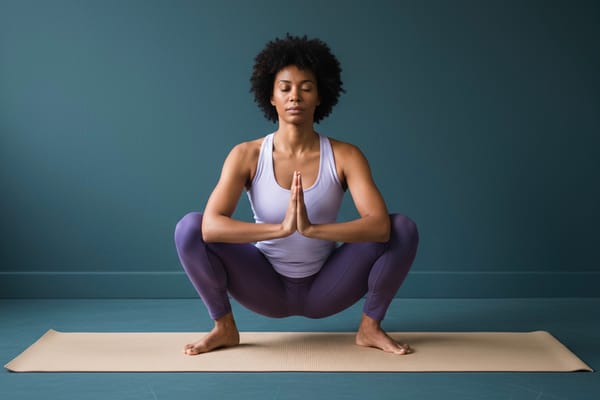
To do a deep squat stretch, stand with feet slightly wider than your hips and toes turned out. Lower your hips as far as you can with heels on the floor. Press your elbows inside your knees and keep your chest up. Hold 30 to 60 seconds, two to three times. Raise your heels on a towel if they lift.
Sitting in a deep squat is a normal resting position in many parts of the world. Children do it without thinking. Many adults who spend their days in chairs find that they can no longer get down there, or that their heels lift and they fall backward as soon as they try.
The deep squat stretch is both the goal and the training tool. Holding the position stretches the ankles, hips, groin and lower back at the same time. With regular practice, most people can make the position far more comfortable within a few weeks.
This guide shows you how to set up the stretch, what usually limits it, and which supporting exercises help you sit lower.
What Limits a Deep Squat
A deep squat needs a large range of motion at three joints: the ankles bend forward, the knees bend fully, and the hips flex deeply. If one joint is short of range, your body tries to make up for it somewhere else, usually by lifting the heels, rounding the back or falling backward.
Research points to two main factors:
Ankle dorsiflexion (how far your shin can move forward over your foot). In a study of 101 healthy adults, ankle dorsiflexion and hip flexion range were linked to how deep people could squat.1 In a group of 147 college athletes, those with a poor score on a deep squat screen were more likely to have limited ankle range in a weight-bearing lunge test.2
Hip flexion. A small study of university students compared people who could and could not do a full deep squat. The group that could squat had more hip flexion and ankle dorsiflexion, and also had a lower body weight and smaller waist measurement.3 Body shape plays a role, which is why there is no single correct squat position for everyone.
Age also has an effect. Older adults in one study squatted less deeply than younger adults, with less ankle and knee bend and more forward lean of the trunk.4 This does not mean older adults cannot improve, but it does mean the supported versions below are a sensible starting point.
How to Do the Deep Squat Stretch
Targets: calves, ankles, groin (adductors), glutes, hips, lower back
Setup:
- Stand with your feet slightly wider than hip-width.
- Turn your toes out about 15 to 30 degrees. Find the angle where your knees can follow your toes comfortably.
How to do it:
- Bend your knees and lower your hips straight down between your heels.
- Go as low as you can while your heels stay on the floor.
- Bring your palms together in front of your chest and press your elbows against the inside of your knees.
- Lift your chest and let your spine lengthen. A small rounding of the lower back at the bottom is normal.
- Breathe slowly and let your hips sink a little further with each exhale.
Hold: 30 to 60 seconds, two to three rounds. As the position becomes comfortable, build up to 2 minutes in total.
To come out: Place your hands on the floor in front of you and push up through your legs, or roll back to sit on the floor.
Key technique points
- Knees follow toes. Let your knees point in the same direction as your second and third toes. Do not let them fall inward.
- Weight in the middle of the foot. You should feel pressure under the heel and the ball of the foot, not only on the toes.
- Use the elbows gently. The elbow press opens the hips. It should feel like a stretch in the groin, not a push that strains the knees.
Common mistakes
Heels lifting: This is the most common problem and usually points to limited ankle range. Use the supported versions below rather than forcing the heels down.
Falling backward: Your center of mass is behind your feet. Reach your arms forward or hold a support in front of you.
Collapsing the knees inward: This often happens when the feet are too narrow or the toes point straight ahead. Widen your stance and turn the toes out a little more.
Holding your breath: Tension makes the position harder. Slow nasal breathing helps the muscles relax.
Supported Versions for Stiff Ankles and Hips
Start with whichever version lets you stay in the squat for 30 seconds without strain.
Heel-Raised Squat
Fold a towel or yoga mat two or three times and place it under your heels. This reduces how much ankle bend you need. Lower the support a little every week or two as your ankles loosen.
Counterweight Squat
Hold a light weight, such as a 2 to 5 kg plate or a filled water bottle, straight out in front of you. The weight moves your center of mass forward, so you are less likely to fall backward.
Door Frame Squat
Hold both sides of a door frame or a sturdy table leg and sit back into the squat. Your arms take some of your weight while your hips and ankles get used to the range. Reduce the help from your arms over time.
Box Squat Hold
Sit down onto a low step, stack of books or yoga block placed under your hips. Relax there for 30 to 60 seconds. This is a good option if your knees feel uncomfortable at full depth.
Prep Exercises That Improve Your Squat
Do two or three of these before your deep squat stretch. They target the specific areas that usually limit the position.
1. Knee-to-Wall Ankle Stretch
Targets: calf (especially the soleus), ankle joint
Setup: Kneel facing a wall with one foot flat on the floor, toes about a hand’s length from the wall.
How to do it:
- Keep your front heel on the floor.
- Drive your front knee forward toward the wall, in line with your second toe.
- Hold for 3 to 5 seconds, back off, and repeat.
Reps: 10 to 12 per side.
Progression: Move your foot a little further from the wall when your knee touches easily.
Common mistake: Letting the heel lift or the knee move inward. Both reduce the stretch on the ankle.
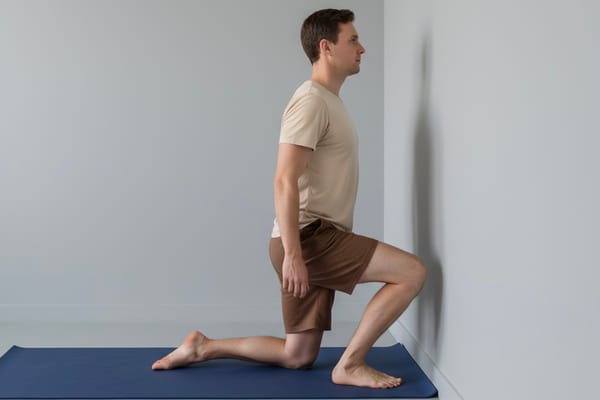
This stretch matches the bent-knee ankle position of a deep squat closely. Our guide to calf stretches and ankle mobility has more options for this area.
2. Leaning Calf Stretch
Targets: gastrocnemius (upper calf)
How to do it: Stand facing a wall with your hands on it. Step one foot back, keep the back leg straight and the heel down, and bend the front knee to lean into the wall.
Hold: 30 to 45 seconds per side.
3. Frog Pose
Targets: adductors (inner thighs), hips
The groin muscles need to lengthen for your knees to move out to the sides at the bottom of a squat.
Setup: Start on hands and knees, then lower onto your forearms.
How to do it:
- Slide your knees out to the sides, keeping your hips in line with your knees.
- Turn your feet out so the inner edges of your feet rest on the floor.
- Slowly press your hips back toward your heels until you feel a stretch in the inner thighs.
Hold: 45 to 60 seconds.
Easier: Keep your knees closer together and place padding under them.
Common mistake: Going too wide too fast. The stretch should build slowly. Sharp pain at the inside of the knee means you need to come out.
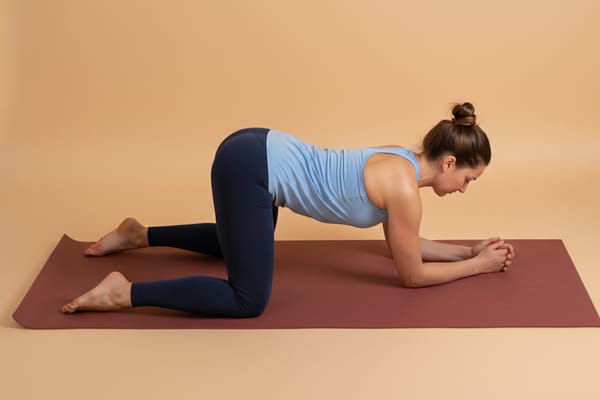
For more inner thigh work, see our groin stretches guide.
4. Side Lunge Hold
Targets: adductors, glutes, hip mobility under load
How to do it: Stand with your feet wide and toes forward. Shift your weight to one side and bend that knee, lowering your hips while the other leg stays straight. Keep the heel of the bent leg down.
Hold: 20 to 30 seconds per side, two rounds.
5. Knees-to-Chest
Targets: hip flexion range, lower back
How to do it: Lie on your back and hug both knees toward your chest. Let your lower back relax into the floor.
Hold: 45 to 60 seconds.
This gives your hips the deep flexion of a squat without any load on your ankles or knees. It is a good choice on days when standing squats feel uncomfortable.
A Daily Deep Squat Routine (10 Minutes)
- Knee-to-wall ankle stretch: 10 reps per side
- Leaning calf stretch: 30 seconds per side
- Frog pose: 60 seconds
- Side lunge hold: 20 seconds per side, two rounds
- Deep squat stretch (supported if needed): 3 holds of 45 seconds, with 20 seconds of rest
- Knees-to-chest: 45 seconds
For a guided session with longer hip holds, try the Hip Opening Foundation routine. When you are comfortable at the bottom, Squat Hold Strength adds strength in the same position. If your ankles are the main limit, add Foot and Ankle Builder a few times a week.
How to Build Squat Time Into Your Day
The fastest progress comes from short, frequent exposure rather than one long session:
- Squat while you wait. Spend 30 seconds in a supported squat while the kettle boils or a file downloads.
- Pick things up from a squat. Instead of bending at the waist to reach something on the floor, lower into a squat.
- Add a minute after workouts. Muscles are warm, so the position often feels easier. Our stretching for weightlifters guide explains how to fit mobility work around training.
- Track your support height. Note how many folds of towel you need under your heels. Fewer folds over time is clear proof of progress.
Most people notice the squat feels easier within two to three weeks. Getting the heels flat at full depth can take two to three months, depending on your ankle range and body shape. Some people may always need a small heel lift, and that is fine.
Who Should Be Careful
The deep squat puts the knees and hips at the end of their range. Be careful, and check with a physiotherapist or doctor first, if you have:
- Knee pain at the front or inside of the knee during deep bending, or a recent meniscus injury. Use the box squat hold and stop above the painful depth. Our article on stretches for knee pain has gentler options.
- A hip replacement. Deep hip flexion may be restricted after surgery. Follow your surgeon’s guidance.
- Pinching in the front of the hip at the bottom of the squat. This can point to a hip joint problem such as impingement and should be assessed if it continues.
- A recent ankle sprain or fracture. Let your physiotherapist guide when you return to full ankle bend.
- Balance problems. Always use the door frame version so you have something to hold.
Stop if you feel sharp pain, locking or catching in the knee, or numbness in the legs. A stretch should feel like strong tension in the muscles, not pain in the joints.
Key Takeaways
- Ankles and hips set the depth: limited ankle dorsiflexion and hip flexion are the most common reasons people cannot sit low.
- Use support without guilt: a heel lift, counterweight or door frame lets you practice the full position safely.
- Short and often works best: several 30- to 60-second holds through the day add up quickly.
- Respect your build: body shape and hip structure affect squat depth, so your best squat may look different from someone else’s.
Frequently Asked Questions
How long should I hold a deep squat stretch?
Start with 30 seconds and repeat two or three times. As the position becomes more comfortable, build up to one to two minutes in total each day. Several short holds spread through the day often work better than one long hold, because you can keep good form and avoid excess pressure on the knees.
Why do my heels come up when I squat deep?
Lifting heels usually means your ankles do not bend forward far enough, often because of stiff calves, especially the soleus. Fall-backward problems can also come from limited hip flexion. Place a folded towel under your heels for now and add the knee-to-wall stretch and calf stretches to your routine to improve ankle range over time.
Is the deep squat stretch bad for your knees?
For healthy knees, a slow bodyweight deep squat is generally safe. The knees are designed to bend fully. People with existing knee pain, meniscus injuries or arthritis may find full depth uncomfortable. In that case, use a box or block under your hips, keep the squat shallower, and ask a physiotherapist which depth suits you.
Can everyone do a full deep squat?
Most people can improve their squat a lot with practice, but not everyone will reach the same position. The shape of the hip socket, leg and trunk proportions and body size all affect squat depth. If you still need a small heel lift after several months of regular practice, that is a normal variation and not a sign of failure.
References
Kim SH, Kwon OY, Park KN, Jeon IC, Weon JH. (2015). Lower extremity strength and the range of motion in relation to squat depth. Journal of Human Kinetics, 45, 59-69. PubMed ↩︎
Lehr ME, Pettineo SJ, Fink ML, Meyr AJ. (2021). Closed chain dorsiflexion and the regional interdependence implications on fundamental movement patterns in collegiate athletes. Foot, 49, 101835. PubMed ↩︎
Okayama Y, Otsuki S. (2024). Effect of soft tissue, range of motion and muscle strength on deep squatting. Journal of Bodywork and Movement Therapies, 40, 650-654. PubMed ↩︎
Honda K, Sekiguchi Y, Shimazaki S, Suzuki R, Suzuki T, Kanetaka H, Izumi S. (2022). Effects of aging on whole-body center of mass movement and lower limb joint kinematics and kinetics during deep-squat movement. Journal of Biomechanics, 134, 110996. PubMed ↩︎
