A good full body stretching routine moves from the neck and shoulders down through the spine, hips and legs in 10 to 20 minutes. Hold each static stretch for 30 to 60 seconds, breathe slowly, and stay at a mild pull rather than pain. Doing it at least two to three days per week keeps every major muscle group mobile.
Most days, stiffness is not limited to one area. Your shoulders round forward at the desk, your hips shorten in the chair, and your calves stiffen from walking all day. A full body stretching routine covers all of it in one session, so no area gets skipped.
This guide gives you 12 stretches in a fixed order, from your neck down to your hips. Each one has setup steps, a hold time, the most common mistake, and an easier and a harder version. At the end you will find a 10-minute and a 20-minute version.
How Much Stretching Do You Actually Need
The American College of Sports Medicine recommends flexibility exercises for each major muscle-tendon group on at least two days per week, with a total of 60 seconds per exercise.1
To become more flexible, a review of 23 studies found that weekly stretching time of at least 5 minutes per muscle group was linked to range of motion gains, and that stretching on more days per week was positively associated with improvement.2
The type of stretching also matters. A meta-analysis of 77 studies found that static stretching and PNF (contract-relax) stretching produced greater long-term gains in range of motion than ballistic or dynamic stretching.3 That is why this routine uses mostly static holds. If you want to know when each type fits best, read our guide to static vs dynamic stretching.
Before You Start
- Warm up for 2 to 3 minutes. March in place and swing your arms.
- Use a mat or carpet. Half of the routine is on the floor.
- Aim for a mild pull, about 5 out of 10. You should be able to breathe slowly.
- Breathe out as you settle deeper, and do both sides of every single-sided stretch.
New to stretching? Start with our beginner’s guide to stretching.
The 12 Stretches
The order goes from standing to kneeling to lying down, so transitions stay short.
1. Neck Side Stretch
What it targets: Upper trapezius and the side of the neck
How to do it:
- Stand or sit tall with your shoulders relaxed
- Tilt your right ear toward your right shoulder
- Rest your right hand lightly on the left side of your head
- Let your left shoulder drop toward the floor
- Hold for 30 seconds, then switch sides
Common mistake: Lifting the shoulder up to meet the ear. Keep both shoulders low and let the head do the moving.
Easier: Skip the hand and let gravity do the work. Harder: Reach the opposite hand toward the floor to increase the pull.
2. Overhead Side Bend
What it targets: Lats, obliques and the side of the ribcage
How to do it:
- Stand with feet hip-width apart
- Reach both arms overhead and hold your left wrist with your right hand
- Gently pull to the right and bend sideways from the waist
- Keep your hips level and your chest facing forward
- Hold for 30 seconds per side
Common mistake: Leaning forward or twisting.
Easier: Keep one hand on your hip. Harder: Cross the outside leg behind the inside leg to add a stretch along the outer hip.
3. Chest Opener
What it targets: Chest, front of the shoulders and biceps
How to do it:
- Stand tall and clasp your hands behind your lower back
- Straighten your arms and draw your shoulder blades together
- Lift your chest slightly and lift your hands away from your back
- Hold for 30 to 45 seconds
Common mistake: Arching the lower back to fake height. Keep your ribs down and let the movement come from the shoulders.
Easier: Hold a towel or strap between your hands if they do not reach. Harder: Hinge forward from the hips and let your arms fall overhead.
4. Standing Forward Fold
What it targets: Hamstrings, calves and the back of the spine
How to do it:
- Stand with feet hip-width apart and knees soft
- Hinge from your hips and let your upper body hang toward the floor
- Let your head and arms hang heavy, or hold opposite elbows
- Hold for 30 to 45 seconds, then roll up slowly
Common mistake: Locking the knees and rounding hard from the lower back. Bend your knees as much as you need to feel the stretch in the back of the thighs.
Easier: Rest your hands on your shins or on a chair. Harder: Straighten your legs more while keeping your back long.
5. Standing Quad Stretch
What it targets: Quadriceps and the front of the hip
How to do it:
- Stand on your left leg and hold a wall or chair for balance
- Bend your right knee and hold your right ankle behind you
- Bring your heel toward your glute and keep both knees close together
- Tuck your tailbone slightly under to feel the stretch move up into the hip
- Hold for 30 seconds per side
Common mistake: Letting the knee drift forward or out to the side.
Easier: Loop a strap around your ankle if you cannot reach it. Harder: Squeeze the glute of the bent leg to add hip extension.
6. Low Lunge
What it targets: Hip flexors, quadriceps and the front of the body
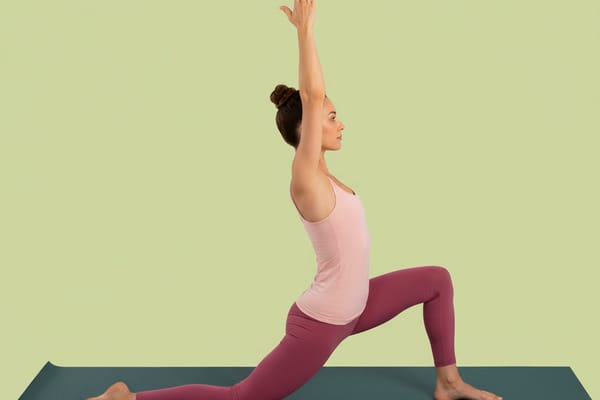
How to do it:
- Kneel on your left knee and place your right foot flat in front of you
- Stack your right knee over your right ankle
- Shift your hips forward until you feel a stretch at the front of the left hip
- Raise both arms overhead and lift through your chest
- Hold for 45 to 60 seconds per side
Common mistake: Sinking into the lower back. Tighten your stomach a little and tuck your tailbone before you shift forward.
Easier: Put a folded towel under the back knee and keep your hands on your front thigh. Harder: Lean slightly toward the side of the front leg to add a side-body stretch. Hip flexors are a common problem area, so our hip flexibility guide covers them in more depth.
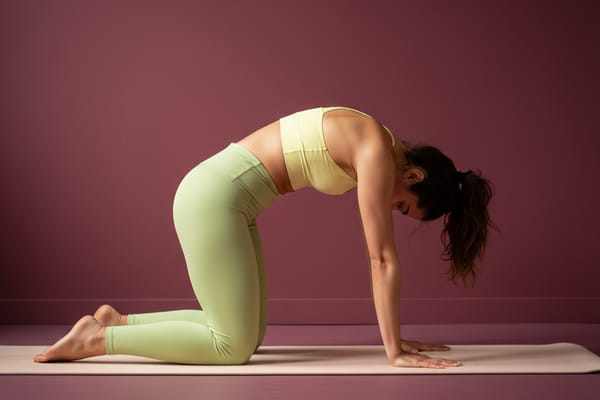
7. Cat Cow
What it targets: The whole spine, from neck to lower back
How to do it:
- Come onto your hands and knees, wrists under shoulders and knees under hips
- Breathe in as you drop your belly, lift your chest and look forward
- Breathe out as you round your back toward the ceiling and tuck your chin
- Move slowly with your breath
- Repeat for 8 to 10 slow cycles
Common mistake: Moving only the neck and lower back. Try to spread the movement evenly along the whole spine.
Easier: Make the range smaller. Harder: Pause for two breaths at each end of the movement.
8. Thread the Needle
What it targets: Upper back, the back of the shoulders and the space between the shoulder blades
How to do it:
- Start on hands and knees
- Slide your right arm under your body toward the left, palm facing up
- Lower your right shoulder and the side of your head to the floor
- Keep your hips above your knees
- Hold for 30 to 45 seconds per side
Common mistake: Letting the hips shift sideways. Keep them square so the twist happens in the upper back.
Easier: Rest your head on a pillow. Harder: Reach the top arm overhead along the floor to lengthen the side body.
9. Downward Dog
What it targets: Calves, hamstrings, shoulders and the back of the spine
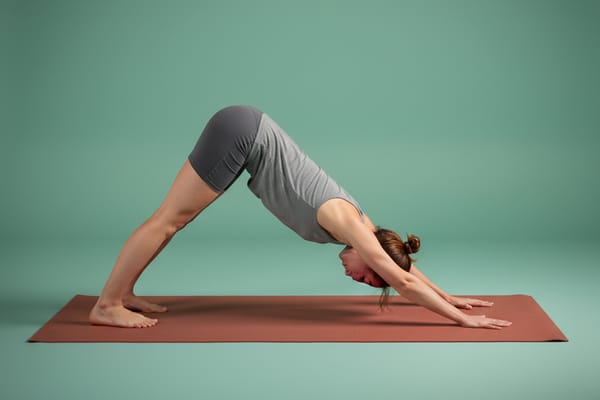
How to do it:
- From hands and knees, tuck your toes and lift your hips up and back
- Press your hands into the floor and push your chest toward your thighs
- Slowly press your heels toward the floor
- Hold for 30 to 45 seconds
Common mistake: Forcing the heels down while the back rounds. A long spine is more important than straight legs.
Easier: Place your hands on a chair seat. Harder: Pedal the feet, bending one knee and then the other, to work into each calf.
10. Pigeon Pose
What it targets: Glutes and the deep rotator muscles of the hip
How to do it:
- From hands and knees, bring your right knee forward behind your right wrist
- Angle your right shin across the mat, with the foot in front of the left hip
- Slide your left leg straight back
- Keep your hips level, then lower your upper body forward over the front leg
- Hold for 45 to 60 seconds per side
Common mistake: Letting the hip of the front leg drop to the floor while the other hip lifts. Put a cushion under the front hip if it does not reach the floor.
Easier: Do a lying figure four instead: lie on your back, cross your right ankle over your left knee and pull the left thigh toward you. Harder: Bring the front shin closer to parallel with the front of the mat.
11. Lying Spinal Twist
What it targets: Lower back, glutes, chest and obliques
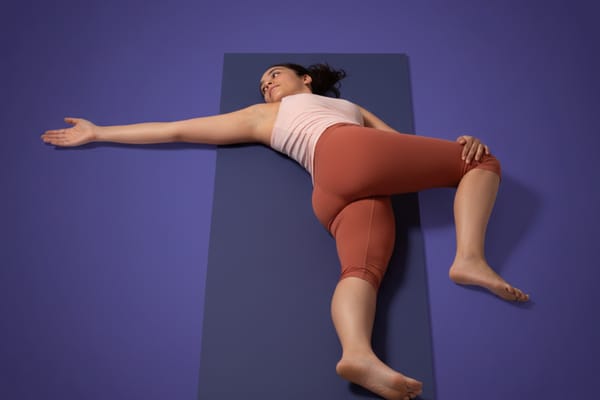
How to do it:
- Lie on your back with both legs straight
- Bend your right knee and place the foot on the floor
- Lower the right knee across your body toward the left
- Place your left hand on the outside of the right knee and stretch your right arm out to the side
- Hold for 45 to 60 seconds per side
Common mistake: Pushing the knee down with force. Let gravity lower it, and keep the opposite shoulder close to the floor.
Easier: Bend both knees and lower them together to one side. Harder: Straighten the top leg and hold the foot with your opposite hand.
12. Child’s Pose
What it targets: Lower back, hips and the tops of the shoulders
How to do it:
- Kneel with your big toes touching and your knees apart
- Sit your hips back toward your heels
- Walk your hands forward and rest your forehead on the floor
- Breathe slowly into your back ribs
- Hold for 60 seconds or longer
Common mistake: Holding tension in the shoulders. Let your arms rest heavy and your shoulders melt away from your ears.
Easier: Put a pillow between your hips and heels. Harder: Walk both hands to one side to add a side-body stretch.
Putting It Together
10-Minute Version
Use this on busy days.
- Overhead side bend: 30 seconds per side
- Chest opener: 30 seconds
- Standing forward fold: 30 seconds
- Low lunge: 45 seconds per side
- Cat cow: 8 slow cycles
- Downward dog: 30 seconds
- Pigeon pose or lying figure four: 45 seconds per side
- Lying spinal twist: 45 seconds per side
Our Quick Reset Stretch routine is a guided five-minute version with a timer.
20-Minute Version
Do all 12 stretches in order. Hold each one for the longer time listed, and repeat the low lunge and pigeon pose a second time if your hips feel tight. The Total Body Reset Flow follows a similar standing-to-floor order with 21 moves and a guided timer. On other days, pair stretching with strength work, such as the isometric holds in the Full Body Hold Forge, so you can control your new range.
When to Do Your Full Body Routine
Any time works. In the morning, keep the holds shorter, or use our morning stretching routine. After a workout your muscles are warm, which makes long holds more comfortable; see our guide to cool down stretches. Before a workout, use short movements such as cat cow and arm circles instead of long holds.
Who Should Be Careful
Some situations call for extra care:
- Recent injury or surgery: Do not stretch an injured area until your doctor or physiotherapist clears you
- Pregnancy: The hormone relaxin makes joints looser, so stay well inside your normal range and avoid deep twists and lying flat on your back later in pregnancy
- Osteoporosis: Avoid deep forward folds and loaded spinal twists, and ask a professional which positions are safe for you
- Hypermobility: If your joints already move further than most, focus on control and strength rather than chasing more range
When to See a Professional
- Sharp, stabbing or electric pain during any stretch
- Numbness or tingling that spreads into an arm or leg
- Joint pain that continues after you stop stretching
- One side that is much tighter than the other and does not change after several weeks
- No improvement after four to six weeks of regular practice
Frequently Asked Questions
How long should a full body stretching routine take?
Ten minutes is enough to cover every major muscle group with one hold each. Twenty minutes lets you hold longer and repeat the tightest areas. If you only have five minutes, focus on the stretches that cover several areas at once, such as the low lunge, downward dog and lying spinal twist.
Is it okay to do a full body stretch every day?
Yes, daily stretching is safe for most healthy adults, as long as you stay at a mild pull and do not force any position. One review linked more stretching days per week with better flexibility gains. If an area feels sore or irritated the next day, reduce the intensity or skip that stretch for a day.
Should I stretch before or after a workout?
Do short, active movements before a workout, such as cat cow, leg swings and arm circles. Save the longer static holds for after your workout or for a separate session. Warm muscles handle long holds more comfortably, and you avoid holding long stretches right before activities that need power.
How long until I see results from full body stretching?
Most people feel looser right after a session, but that effect fades within hours. Lasting changes in flexibility usually take four to eight weeks of regular stretching, at least two to three times per week. Keep a simple note of one test, such as how far you can reach in a forward fold, to track progress.
References
Garber CE, Blissmer B, Deschenes MR, et al. (2011). American College of Sports Medicine position stand. Quantity and quality of exercise for developing and maintaining cardiorespiratory, musculoskeletal, and neuromotor fitness in apparently healthy adults: guidance for prescribing exercise. Medicine and Science in Sports and Exercise, 43(7), 1334-1359. PubMed ↩︎
Thomas E, Bianco A, Paoli A, Palma A. (2018). The Relation Between Stretching Typology and Stretching Duration: The Effects on Range of Motion. International Journal of Sports Medicine, 39(4), 243-254. PubMed ↩︎
Konrad A, Alizadeh S, Daneshjoo A, et al. (2024). Chronic effects of stretching on range of motion with consideration of potential moderating variables: A systematic review with meta-analysis. Journal of Sport and Health Science, 13(2), 186-194. PubMed ↩︎
