The groin is one of those areas most people ignore until something goes wrong. Tight adductors limit how well you can squat, lunge, and move laterally. They pull on your pelvis and contribute to hip and lower back discomfort. And when they finally give out during a sudden change of direction, the resulting strain can sideline you for weeks.
Groin injuries account for roughly 10% of all injuries in sports like hockey and soccer, with previous injury and adductor weakness being the strongest risk factors.12 The good news is that regular stretching and strengthening of the hip adductors significantly reduces your risk while improving overall hip mobility.
This guide covers why your groin gets tight, the best stretches to fix it, and complete routines you can follow today.

Why Your Groin Feels Tight
Sitting Shortens Your Adductors
Your adductor muscles run along the inner thigh from the pelvis to the knee. When you sit for hours with your legs together or crossed, these muscles stay in a shortened position. Over time, the nervous system treats that shortened length as normal and resists any attempt to lengthen beyond it.
Athletic Demands Without Matching Flexibility
Sports that involve kicking, sprinting, and lateral cutting place massive demands on the adductors. Research using biomechanical modeling found that the adductor longus reaches its maximum stretch rate during the transition phase of a soccer kick, making it particularly vulnerable during explosive movements.3 If your resting flexibility cannot accommodate those peak demands, the risk of strain increases.
Hip Joint Restrictions
Tight adductors rarely exist in isolation. Limited hip rotation, stiff hip flexors, and restricted external rotation all contribute to the sensation of groin tightness. A multi-directional approach to hip mobility tends to produce better results than targeting the adductors alone.4
Signs Your Groin Needs Attention
- Pinching or pulling during squats: Feeling a catch in the inner thigh at the bottom of a squat suggests shortened adductors limiting hip abduction
- Difficulty sitting cross-legged: If your knees sit significantly higher than your hips in a cross-legged position, adductor flexibility is limited
- Asymmetry between sides: One groin feeling noticeably tighter than the other is common and worth addressing before it becomes a compensation pattern
- Inner thigh soreness after lateral movements: Persistent soreness from side lunges, skating, or court sports indicates the adductors are working beyond their comfortable range
- Lower back tension that does not respond to back stretches: Tight adductors alter pelvic alignment, which can refer tension to the lower back
The Best Groin Stretches
Butterfly
The butterfly is the most accessible groin stretch and a great starting point for gauging your current flexibility. It targets the adductor longus and brevis while gently opening the hips.
How to do it:
- Sit on the floor with the soles of your feet together
- Let your knees drop out to the sides
- Hold your feet or ankles and sit tall through your spine
- Gently press your knees toward the floor using your elbows
- Hold for 30 to 60 seconds
Tip: If your knees are very high, sit on a folded blanket or yoga block to tilt your pelvis forward and make the stretch more comfortable.
Frog Pose
Frog pose provides a deeper adductor stretch than butterfly because gravity helps pull you into the position. It is particularly effective for people who feel limited at the bottom of a squat.
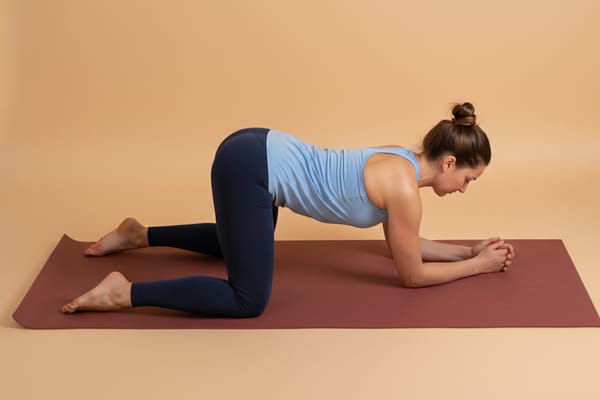
How to do it:
- Start on all fours with your hands under your shoulders
- Slowly walk your knees out wide, keeping them in line with your hips
- Turn your feet outward so the inner edges rest on the floor
- Lower your forearms to the ground
- Gently shift your hips back until you feel a deep stretch through both inner thighs
- Hold for 30 to 90 seconds
Adjustments: If this feels too intense, keep your hands on the ground instead of dropping to your forearms, or place a pillow under your hips.
Side Lunge
The side lunge is the best standing groin stretch and easy to work into any warm-up. It stretches one adductor at a time, which helps you identify asymmetry between sides.
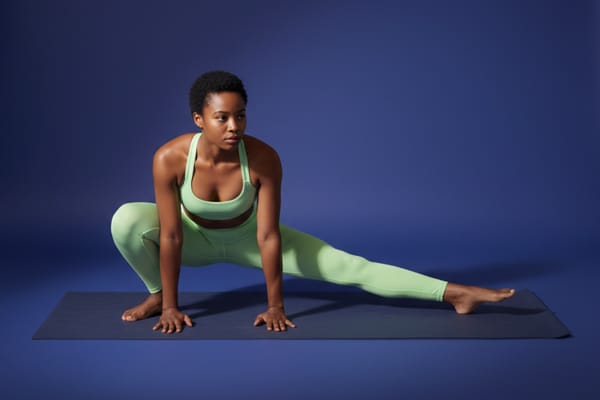
How to do it:
- Stand with your feet about double hip-width apart
- Shift your weight to one side, bending that knee while keeping the other leg straight
- Point the toes of both feet forward
- Sink your hips down and back until you feel a stretch along the inner thigh of the straight leg
- Hold for 30 seconds, then switch sides
Tip: Keep your chest lifted and your weight in your heel on the bent-leg side. If your heel lifts, reduce the width of your stance.
Seated Straddle
The seated straddle is an effective stretch for both the adductors and hamstrings. It also helps build the hip abduction range needed for activities like martial arts and dance.
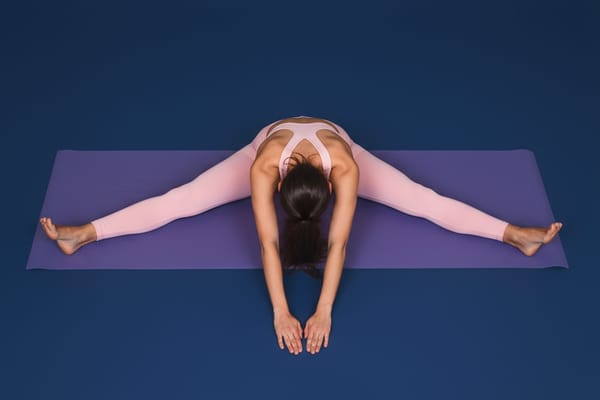
How to do it:
- Sit on the floor with your legs spread wide in a V shape
- Keep your toes pointing up toward the ceiling
- Sit tall, then slowly hinge forward from your hips
- Walk your hands forward along the floor
- Hold wherever you feel a comfortable stretch for 30 to 60 seconds
Adjustments: If you cannot sit upright with your legs wide, sit on a folded towel to elevate your hips. You can also reduce how wide your legs are spread.
Squat Stretch
The deep squat stretch opens the groin while simultaneously mobilizing the ankles and hips. It mimics a position your body was designed to use regularly.
How to do it:
- Stand with your feet slightly wider than shoulder-width, toes turned out about 30 degrees
- Squat down as deep as you can, ideally with your hips below your knees
- Bring your palms together in front of your chest
- Press your elbows against the inside of your knees to push them outward
- Hold for 30 to 60 seconds
Tip: If your heels lift off the ground, place a rolled towel or small plate under them for support.
Happy Baby
Happy baby is a relaxed, floor-based stretch that targets the groin and inner hips. It is a great option for the end of a stretching session when your muscles are already warm.
How to do it:
- Lie on your back and bring your knees toward your chest
- Grab the outside edges of your feet
- Pull your knees toward your armpits while keeping your tailbone on the floor
- Gently rock side to side if that feels good
- Hold for 30 to 60 seconds
Lizard Pose
Lizard pose provides a deep stretch for the groin, hip flexors, and adductors simultaneously. It is one of the most effective positions for athletes who need both hip extension and abduction range.
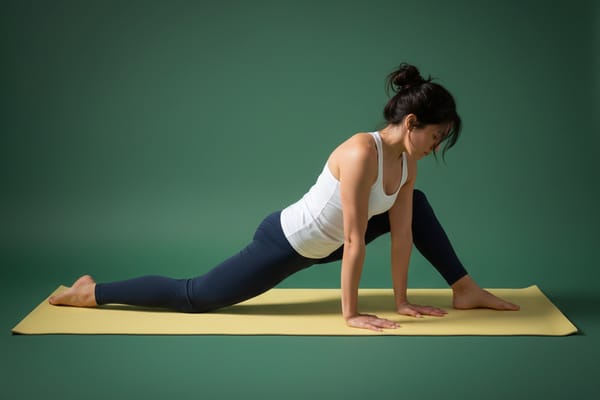
How to do it:
- Start in a lunge position with your right foot forward
- Place both hands on the inside of your right foot
- Lower your left knee to the ground
- Walk your right foot out slightly to the right
- Drop to your forearms if your flexibility allows
- Hold for 30 to 60 seconds, then switch sides
Adjustments: Keep your hands on the floor or on a yoga block if your forearms do not reach comfortably.
Building a Groin Stretching Routine
Quick Release (5 minutes)
For a fast daily routine that keeps your adductors mobile:
- Side lunge: 30 seconds each side
- Butterfly: 60 seconds
- Squat stretch: 60 seconds
- Happy baby: 60 seconds
Comprehensive Session (15 minutes)
For deeper flexibility work, do this routine 3 to 4 times per week:
- Side lunge: 30 seconds each side
- Squat stretch: 60 seconds
- Butterfly: 60 seconds
- Frog pose: 60 to 90 seconds
- Seated straddle: 60 seconds
- Lizard pose: 45 seconds each side
- Happy baby: 60 seconds
For a guided version, try the Hip Immersion Lab or Deep Hip Release Session routines.
Post-Workout Groin Stretch
After any workout that involves squatting, lunging, or lateral movement:
- Side lunge: 30 seconds each side
- Butterfly: 45 seconds
- Frog pose: 60 seconds
- Happy baby: 45 seconds
Stretching Alone May Not Be Enough
Research consistently shows that adductor strength is just as important as flexibility for preventing groin injuries. A landmark RCT of 652 football players found that the Copenhagen Adduction exercise reduced groin problems by 41%.5 Another study confirmed that hip adductor strengthening programs significantly decreased adductor strain rates in professional athletes.1
The most effective approach combines stretching to restore range of motion with strengthening exercises to build control and resilience in that range. Consider adding adductor squeezes, Copenhagen side planks, or banded hip adductions alongside your stretching routine.
How Long Until You See Results
Most people notice a difference in their groin flexibility within 2 to 3 weeks of consistent stretching. A study on hip adductor ROM found significant improvements from just a single stretching session, though lasting changes require regular practice.4 An RCT comparing different stretching methods for adductor tightness showed meaningful ROM gains across all groups after a focused intervention period.6
For substantial flexibility changes (like getting deeper into a straddle or comfortably sitting cross-legged), expect 6 to 12 weeks of dedicated work, stretching at least 3 to 4 times per week. Foam rolling can accelerate your progress. A study on rugby players found that foam rolling improved lower limb ROM by 8 to 20% over 5 to 7 weeks.7
When to See a Professional
- Sudden sharp pain in the groin during activity: This could indicate an adductor strain that needs proper assessment
- Pain that does not improve after 2 weeks of rest and gentle stretching: Persistent groin pain has many possible causes, including hip joint pathology
- Clicking, locking, or catching in the hip joint: These symptoms suggest something beyond simple muscle tightness
- Groin pain combined with lower abdominal pain: This pattern may indicate a sports hernia or other condition requiring medical evaluation
- Numbness or tingling in the inner thigh: Nerve involvement warrants professional assessment
Key Takeaways
- Groin tightness is extremely common: Prolonged sitting and sports without adequate mobility work are the biggest contributors
- Multi-directional stretching works best: Targeting the adductors from multiple angles (butterfly, frog, side lunge, straddle) produces better results than repeating a single stretch
- Combine stretching with strengthening: Research shows that adductor strength is the strongest modifiable risk factor for groin injury prevention
- Consistency matters more than intensity: Regular 5 to 15 minute sessions outperform occasional aggressive stretching
- Results come quickly: Most people feel a meaningful difference within 2 to 3 weeks of daily practice
Related Articles
- The Complete Hip Flexibility Guide
- Why Your Hip Flexors Are Always Tight
- The Best Glute Stretches
- Stretching for Knee Pain
References
Nicholas SJ, Tyler TF. (2002). Adductor muscle strains in sport. Sports Medicine, 32(5), 339-44. PubMed ↩︎ ↩︎
Whittaker JL, et al. (2015). Risk factors for groin injury in sport: an updated systematic review. British Journal of Sports Medicine, 49(12), 803-9. PubMed ↩︎
Charnock BL, et al. (2009). Adductor longus mechanics during the maximal effort soccer kick. Sports Biomechanics, 8(3), 223-34. PubMed ↩︎
Hammer AM, et al. (2017). Acute changes of hip joint range of motion using selected clinical stretching procedures: a randomized crossover study. Musculoskeletal Science & Practice, 32, 70-77. PubMed ↩︎ ↩︎
Haroy J, et al. (2018). The Adductor Strengthening Programme prevents groin problems among male football players: a cluster-randomised controlled trial. British Journal of Sports Medicine, 53(3), 150-157. PubMed ↩︎
Metgud SC, et al. (2022). Immediate effect of MWM adductor stretch, myofascial release, and conventional stretching in asymptomatic individuals with hip adductor tightness: a randomized controlled trial. Journal of Bodywork and Movement Therapies, 32, 213-217. PubMed ↩︎
Guillot A, et al. (2019). Foam Rolling and Joint Distraction with Elastic Band Training Performed for 5-7 Weeks Respectively Improve Lower Limb Flexibility. Journal of Sports Science & Medicine, 18(1), 160-171. PubMed ↩︎
