Pigeon pose (Eka Pada Rajakapotasana in Sanskrit) is one of the most effective and most commonly performed hip stretches. It targets the external rotators, glutes, and hip capsule in ways that few other stretches can match.
It is also frequently performed incorrectly, creating strain rather than productive stretch. And for some body types, it may not be the best choice at all.
This guide covers proper technique, essential modifications, who benefits most from pigeon, and when to choose alternatives.
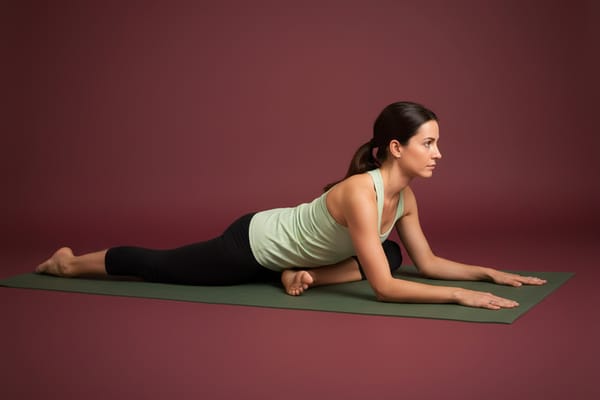
What Pigeon Pose Targets
The front leg in pigeon pose is positioned in hip flexion with external rotation.1 This combination stretches:
Primary targets:
- Piriformis
- Other deep external rotators (obturator internus and externus, gemellus superior and inferior, quadratus femoris)
- Gluteus medius and minimus (posterior fibers)
- Hip joint capsule
Secondary targets:
- The back leg receives a hip flexor stretch (when positioned correctly)
- The spine may receive a gentle extension if folding forward
The piriformis in particular responds well to pigeon pose.2 This deep muscle runs close to (and sometimes around) the sciatic nerve, and tension here can contribute to sciatica-like symptoms.
Proper Technique
Getting Into the Pose
- Start in tabletop position (hands and knees)
- Bring your right knee forward toward your right wrist
- Lower your right shin toward the floor (the angle will vary based on your flexibility)
- Slide your left leg straight back, keeping the top of the foot on the floor
- Lower your pelvis toward the floor
Alignment Points
Front leg:
- Knee tracks toward the corner of the mat (not directly forward)
- Shin angle varies: beginners may have heel close to hip; advanced practitioners may have shin parallel to front of mat
- Ankle is flexed (toes pulled back) to protect the knee
Back leg:
- Extends straight back, not angled out
- Top of foot rests on floor
- Hip points toward the floor (not rolled open)
Pelvis:
- Both hip bones face forward as much as possible
- Hips level, not tilted to one side
- May be lifted on a block or blanket if needed
Torso:
- Can remain upright, or fold forward over the front leg
- Spine stays long (avoid excessive rounding)
Common Mistakes
Mistake 1: Hip rolling open
When the hip on the front leg side lifts and rotates back, the stretch bypasses the target muscles. The pelvis should stay as square as possible.
Fix: Place a block or folded blanket under the front hip to level the pelvis.
Mistake 2: Knee strain
If the knee of the front leg hurts, the joint is taking load it should not bear.
Fix: Keep the ankle flexed and reduce the shin angle. Consider supine pigeon (figure four) instead.
Mistake 3: Ignoring the back leg
The back leg should extend straight back with the hip moving toward extension. Many people let it drift to the side, missing the hip flexor stretch.
Fix: Check that the back leg extends directly behind you, not angled out.
Mistake 4: Forcing depth
Aggressively pushing into the pose creates protective tension and increases injury risk.
Fix: Enter gradually and only go as deep as you can with relaxed breathing.
Modifications for Different Levels
Beginner: Supported Pigeon
- Place a block or folded blanket under the front hip
- Keep the front heel closer to the hip (smaller shin angle)
- Stay upright rather than folding forward
- Hold for 30-45 seconds per side
Intermediate: Standard Pigeon
- Front hip may touch the floor or be slightly lifted
- Shin angle increases as flexibility allows
- Fold forward over the front leg, resting on forearms or extending arms
- Hold for 45-60 seconds per side
Advanced: Deep Pigeon
- Shin approaches parallel to the front of the mat
- Fold fully forward, chest toward floor
- Extended holds of 60-90+ seconds
- May add back bend variation (reaching back for back foot)
Alternatives to Pigeon
For some people, pigeon pose is not ideal. Alternatives that target similar structures:
Supine Pigeon (Figure Four)
Lie on your back, cross one ankle over the opposite knee, and pull the uncrossed leg toward your chest. This provides a similar stretch with less knee stress and more control.
Best for: Beginners, those with knee sensitivity, anyone wanting a gentler variation
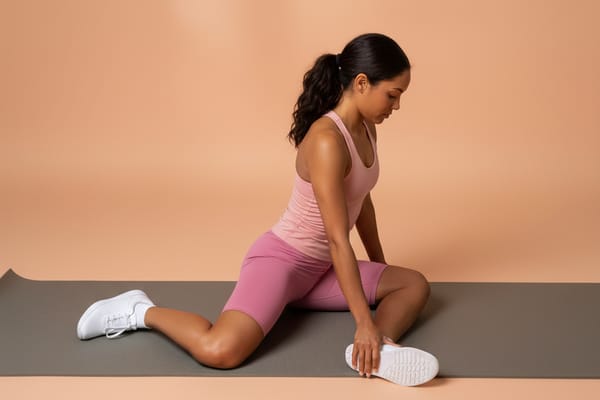
90/90 Stretch
Sit with both legs bent at 90 degrees (one in front, one to the side). This addresses external and internal rotation simultaneously.
Best for: Those wanting comprehensive hip rotation work
Thread the Needle (Side-Lying)
Lie on your side with the bottom knee bent and pull the top leg across your body, letting the knee drop. Rotate your torso away.
Best for: Those who find pigeon uncomfortable in any variation
Who Should Be Careful With Pigeon
Knee Issues
The front knee in pigeon takes rotational stress. Those with knee injuries, meniscus problems, or chronic knee pain should often choose alternatives like supine pigeon.
Hip Impingement
Femoroacetabular impingement (FAI) can cause pinching sensations in deep hip flexion with rotation. If pigeon creates a pinching feeling in the front of the hip (not a stretching sensation in the back), modify or avoid.
SI Joint Dysfunction
The asymmetric position of pigeon can stress the sacroiliac joint. Those with SI problems may need to limit time in the pose or use alternatives.
Pregnancy
As pregnancy progresses, the asymmetric nature of pigeon may become uncomfortable. Supine pigeon or other modifications may work better.
Programming Pigeon Pose
Within a Flexibility Routine
Pigeon works well after general hip warmup movements. Include it alongside other hip stretches for comprehensive coverage.
Sequence example:
- Cat-cow (spine warmup)
- Hip circles (mobilization)
- Low lunge (hip flexor)
- Pigeon (external rotators)
- Supine twist (rotation)
Frequency
3-5 times per week is appropriate for most people. Daily practice is fine if there is no discomfort.
Duration
- 30-45 seconds per side for maintenance
- 60-90 seconds per side for flexibility development
- Up to 2-3 minutes per side for deep release (advanced)
Our Hip Flexibility Expansion and Hip Immersion Lab routines incorporate pigeon with appropriate progressions.
Key Takeaways
- Pigeon targets deep hip rotators and glutes: Few stretches reach these structures as effectively
- Technique matters: Keep hips level, protect the knee, extend the back leg properly
- Modify as needed: Blocks, blankets, and variations make pigeon accessible at any level
- Alternatives exist: Supine pigeon provides similar benefits with less knee stress
- Listen to discomfort: Pain (especially in the knee or front hip) signals a need to modify
Related Articles
- The Complete Hip Flexibility Guide
- Why Your Hip Flexors Are Always Tight
- Complete Beginner’s Guide to Stretching
References
Itsuda H, Yagi M, Yanase K, et al. (2024). Effective Stretching Positions of the Piriformis Muscle Evaluated Using Shear Wave Elastography. Journal of Sport Rehabilitation, 33(4), 282-288. PubMed ↩︎
Gulledge BM, Marcellin-Little DJ, Levine D, et al. (2013). Comparison of two stretching methods and optimization of stretching protocol for the piriformis muscle. Medical Engineering & Physics, 36(2), 212-218. PubMed ↩︎
