Poor posture is not really about laziness or forgetting to sit up straight. It is a muscle imbalance problem. Certain muscles get tight, others get weak, and your body settles into the path of least resistance: shoulders rounded, head forward, upper back curved.
The pattern is so common it has a clinical name. Upper crossed syndrome describes the specific combination of tight pectorals and upper traps crossed with weak deep neck flexors and lower trapezius. Research shows that 55 to 69% of computer users develop neck pain and 15 to 52% develop shoulder pain, with this muscle imbalance pattern identified as a primary contributor.1
The fix requires both stretching the tight muscles and strengthening the weak ones. Here are the posture exercises that research supports, how to do them correctly, and how to build a routine that produces lasting change.

Why Your Posture Deteriorates
The Muscle Imbalance Pattern
Your body adapts to the positions you spend the most time in. If you sit at a desk for 8 hours, your chest muscles shorten, your upper back muscles weaken, and your head drifts forward. The longer these positions are held, the more your nervous system treats them as normal.
A 2024 meta-analysis of 22 studies confirmed that this pattern creates measurable changes: increased forward head angle, rounded shoulders, and excessive thoracic kyphosis (upper back rounding).2 The tight muscles pull, the weak muscles cannot counterbalance, and the structural shift becomes self-reinforcing.
What Makes It Worse
Several factors accelerate postural decline:
- Prolonged sitting: The average adult sits 9+ hours per day. Every hour of sustained sitting increases back muscle temperature and strain, as measured by infrared thermography in office workers.3
- Screen time: Looking down at phones adds up to 27 kg of force on the cervical spine at 60 degrees of flexion
- Push-heavy training: Bench press and push-ups without matching pulling volume tightens the chest further
- Stress: Shallow breathing overuses the pectoralis minor, keeping it in a chronically shortened state
Why “Just Sit Up Straight” Does Not Work
Consciously correcting your posture without addressing the underlying imbalance is exhausting. Your weak muscles fatigue within minutes, and you slump back. A systematic review of 11 treatment studies found that structured exercise programs targeting the specific muscle imbalances are effective for decreasing pain and improving postural deviations, while passive reminders alone are not.4
The Stretching Exercises: Open What Is Tight
The first half of posture correction is lengthening the muscles that have become short. Focus on the chest, front of shoulders, upper traps, and neck.
Chest Opener
The simplest and most accessible posture stretch. You can do this anywhere, and it directly counteracts the forward-pulling position of desk work.
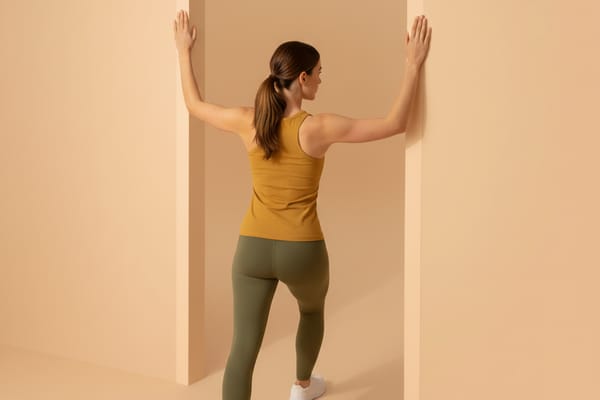
How to do it:
- Stand tall with feet hip-width apart
- Clasp your hands behind your lower back
- Straighten your arms and gently lift them away from your body
- Squeeze your shoulder blades together and lift your chest
- Hold for 30 seconds
Why it works: This position simultaneously stretches the pectoralis major and activates the rhomboids and lower trapezius, addressing both sides of the imbalance at once.
Doorway Pec Stretch
The doorway provides a stable anchor for a deeper chest stretch than you can achieve standing alone. This targets the pectoralis major and minor more aggressively.
How to do it:
- Stand in a doorway with one arm bent at 90 degrees, forearm resting against the frame
- Step forward with the foot on the same side as the stretched arm
- Rotate your torso gently away from the arm until you feel a stretch across the chest
- Hold for 30 to 60 seconds, then switch sides
Tip: Elbow at shoulder height targets the middle chest fibers. Elbow above shoulder height targets the lower fibers. Elbow below targets the upper chest and clavicular fibers. Work all three positions for complete coverage.
Cat-Cow
Cat-cow mobilizes the thoracic spine through flexion and extension, breaking the pattern of sustained rounding. It also teaches body awareness of spinal positioning.
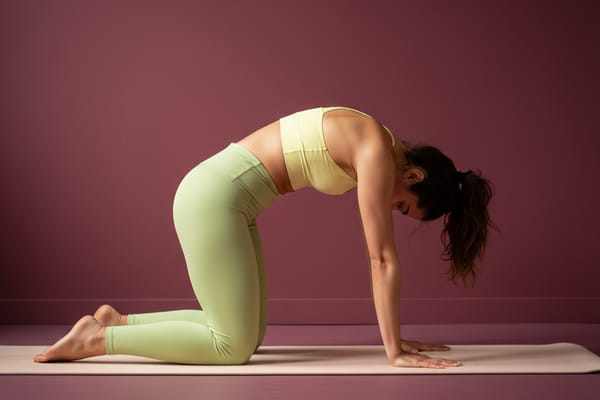
How to do it:
- Start on hands and knees, wrists under shoulders, knees under hips
- Cow: Inhale, drop your belly toward the floor, lift your chest and tailbone
- Cat: Exhale, round your spine toward the ceiling, tuck your chin
- Move slowly between positions for 10 repetitions
Thread the Needle
This stretch targets thoracic rotation, which is often restricted in people with poor posture. Limited rotation forces the lumbar spine and shoulders to compensate during everyday movements.
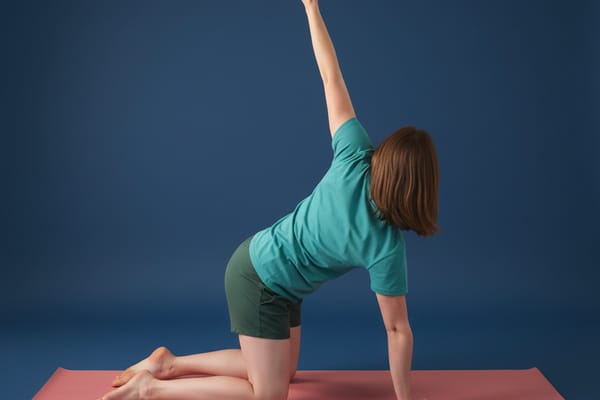
How to do it:
- Start on hands and knees
- Slide your right arm underneath your left arm, lowering your right shoulder to the floor
- Keep your hips stacked over your knees
- Hold for 30 seconds, then switch sides
Chin Retractions
Forward head posture places excessive strain on the cervical spine. Chin retractions strengthen the deep neck flexors while stretching the tight suboccipital muscles at the base of the skull.
How to do it:
- Sit or stand tall with your gaze level
- Draw your chin straight back (like making a double chin) without tilting your head up or down
- Hold for 5 seconds
- Release and repeat 10 to 15 times
Why it works: A randomized controlled trial found that exercises targeting the deep cervical flexors (like chin retractions) significantly improved forward head posture within 4 weeks.5
Shoulder Opener
This stretch addresses tightness in the anterior deltoid and pectoralis major that contributes to internally rotated (rounded) shoulders.
How to do it:
- Stand next to a wall
- Extend your arm behind you and place your palm flat on the wall at shoulder height
- Slowly rotate your body away from the wall until you feel a stretch across the front of your shoulder and chest
- Hold for 30 seconds, then switch sides
The Strengthening Exercises: Activate What Is Weak
Stretching alone only solves half the problem. Without strengthening the opposing muscles, the tight ones will simply pull you back into the same position. Research consistently shows that combining stretching with strengthening produces better postural outcomes than either approach alone.26
Cactus Arms (Wall Angels Variation)
This exercise strengthens the lower trapezius and rhomboids while stretching the pectorals. It is one of the most effective exercises for reversing rounded shoulders.
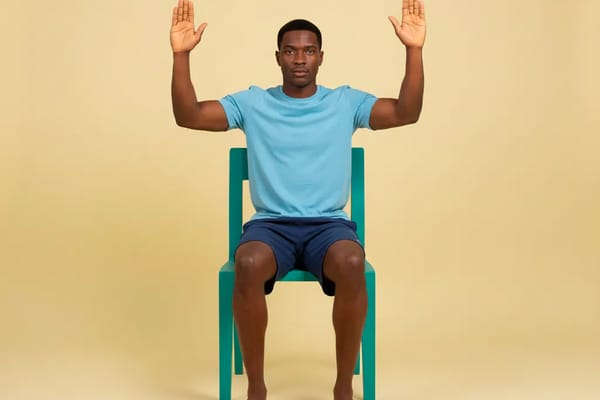
How to do it:
- Stand with your back against a wall, feet about 15 cm away
- Raise your arms to shoulder height with elbows bent at 90 degrees (goalpost position)
- Try to press your wrists, elbows, and back of hands against the wall
- Slowly slide your arms up and down the wall for 10 repetitions
- On the final rep, hold the top position for 15 seconds
Tip: If you cannot get your arms flat against the wall, that is fine. Work within your available range. The gap between your arms and the wall will close as your chest opens and upper back strengthens.
Scapular Squeezes
Simple but effective. This exercise directly targets the muscles responsible for pulling the shoulder blades back and down into proper position.
How to do it:
- Sit or stand with arms at your sides
- Squeeze your shoulder blades together and slightly down
- Hold for 5 to 10 seconds
- Release slowly and repeat 10 to 15 times
Prone Y Raises
This exercise strengthens the lower trapezius, which is one of the most consistently weak muscles in people with poor posture.
How to do it:
- Lie face down on the floor with your arms extended overhead in a Y position, thumbs pointing up
- Lift your arms off the ground by squeezing your shoulder blades together
- Hold for 3 to 5 seconds at the top
- Lower slowly and repeat 10 to 12 times
Bird Dog
Bird dog strengthens the entire posterior chain (back extensors, glutes, core) while training the coordination needed for upright posture.
How to do it:
- Start on hands and knees
- Extend your right arm forward and left leg back simultaneously
- Keep your hips level and your core engaged
- Hold for 5 seconds, then return to start
- Alternate sides for 10 repetitions total
What the Research Says
The evidence for posture-specific exercise programs is strong and getting stronger.
A 2020 randomized controlled trial tested a comprehensive corrective exercise program (combining stretching and strengthening) in men with upper crossed syndrome.6 After 8 weeks, the exercise group showed significant improvements in muscle activation patterns, movement quality, and postural alignment. Most importantly, these improvements were maintained even after 4 weeks of detraining, suggesting that the neuromuscular changes became lasting habits rather than temporary corrections.
A separate RCT focused specifically on scapular stabilization exercises using elastic bands found that just 4 weeks of training (3 days per week) significantly improved forward head and shoulder posture, increased pectoralis minor length, and strengthened the scapular muscles.5
For thoracic kyphosis specifically, both resistance band exercises and general active exercises (stretching plus extension work) significantly reduced kyphosis measures after 4 weeks of training.7 Interestingly, there was no significant difference between the two approaches, suggesting that consistency matters more than the specific method.
Building Your Posture Exercise Routine
Quick Reset (3 minutes, do 2 to 3 times daily)
Perfect for breaking up desk work:
- Chin retractions: 10 reps
- Chest opener: 30 seconds
- Scapular squeezes: 10 reps with 5-second holds
- Cactus arms: 8 reps
The Posture Reset Stretches routine provides a guided version of this that you can follow along with.
Daily Posture Practice (10 minutes)
For steady improvement, do this once daily:
- Cat-cow: 10 slow reps (warm-up)
- Doorway pec stretch: 30 seconds each side, 3 arm positions
- Thread the needle: 30 seconds each side
- Chin retractions: 15 reps
- Cactus arms against wall: 10 reps
- Prone Y raises: 12 reps
- Bird dog: 10 reps alternating
For a guided flow, try the Posture Lengthening Flow for the stretching portion and the Posture Hold Circuit for strengthening.
Comprehensive Program (15 to 20 minutes, 3 times per week)
For significant postural change, follow a program that mirrors what research has shown to work:
- Cat-cow: 10 reps
- Thread the needle: 45 seconds each side
- Doorway pec stretch (all 3 heights): 30 seconds each position, both sides
- Shoulder opener: 30 seconds each side
- Chin retractions: 15 reps
- Cactus arms: 12 reps
- Prone Y raises: 15 reps
- Bird dog: 12 reps alternating
- Scapular squeezes: 15 reps with 5-second holds
The Posture Stability Lab routine covers the strengthening component with guided holds and progressions.
How Long Until You See Results
Research provides clear timelines:
- 1 to 2 weeks: Reduced tension and discomfort, especially in the upper back and between the shoulder blades
- 4 weeks: Measurable improvements in head position, shoulder angle, and pectoralis minor length.5 An RCT showed significant postural changes at the 4-week mark with exercises performed 3 days per week
- 8 weeks: A comprehensive corrective program produced improvements in alignment, muscle activation, and movement patterns that persisted even after stopping the program.6
The key factor is consistency, not intensity. Three 10-minute sessions per week produces better results than one long session followed by days of nothing.
Common Mistakes
Only Stretching (Skipping Strengthening)
This is the most common error. Stretching your chest without strengthening your upper back provides temporary relief but does not change the underlying imbalance. Research consistently shows that combined programs outperform stretching alone.2
Going Too Hard Too Fast
Posture correction is a gradual process. Forcing your shoulders back aggressively or doing excessive backbends can irritate joints and create new problems. Start with the quick reset routine and build from there.
Expecting Overnight Results
Your posture developed over years. Four weeks of consistent work produces measurable changes, but lasting transformation requires making these exercises a regular habit. The good news is that the research shows improvements persist even when you reduce frequency after the initial correction period.6
Ignoring the Rest of the Day
Exercise is important, but it cannot overcome 10 hours of poor positioning. Combine your exercise routine with practical changes: monitor at eye level, standing desk intervals, and movement breaks every 30 to 45 minutes. Active breaks during sitting have been shown to significantly reduce back muscle overload compared to uninterrupted sitting.3
When to See a Professional
- Pain during exercises: Sharp pain (not stretch discomfort) during any of these movements needs assessment
- Numbness or tingling: Especially down the arms or into the hands, which could indicate nerve involvement
- No improvement after 6 weeks: If consistent practice produces no change, a physiotherapist can identify structural factors that exercises alone cannot address
- History of spinal injury or surgery: Get clearance before starting a posture exercise program
Key Takeaways
- Posture is a muscle imbalance problem: Tight pectorals and upper traps combined with weak lower traps and deep neck flexors create the classic rounded posture
- Stretch and strengthen together: Research shows combined programs produce significantly better outcomes than stretching alone
- 4 weeks to measurable change: RCTs show significant postural improvements at the 4-week mark with 3 sessions per week
- Consistency beats intensity: Short daily sessions outperform occasional long ones
- Results last: Neuromuscular improvements persist even after reducing exercise frequency
Related Articles
- Chest Stretches: How to Open Up Tight Pecs
- Upper Back Stretches: Relieve Stiffness and Improve Posture
- Tech Neck: Causes, Symptoms, and Stretches
- Stretching for Desk Workers: The Complete Daily Plan
- The Complete Shoulder Mobility Guide
References
Russin NH, Robertson C, Montalvo A. (2026). Upper Crossed Syndrome in the Workplace: A Narrative Review with Clinical Recommendations for Non-Pharmacologic Management. International Journal of Environmental Research and Public Health, 23(1), 120. PubMed ↩︎
Sepehri S, Sheikhhoseini R, Piri H, Sayyadi P. (2024). The effect of various therapeutic exercises on forward head posture, rounded shoulder, and hyperkyphosis among people with upper crossed syndrome: a systematic review and meta-analysis. BMC Musculoskeletal Disorders, 25(1), 105. PubMed ↩︎ ↩︎ ↩︎
Sortino M, Trovato B, Zanghi M, Roggio F, Musumeci G. (2024). Active Breaks Reduce Back Overload during Prolonged Sitting: Ergonomic Analysis with Infrared Thermography. Journal of Clinical Medicine, 13(11), 3178. PubMed ↩︎ ↩︎
Chang MC, Choo YJ, Hong K, Boudier-Revet M, Yang S. (2023). Treatment of Upper Crossed Syndrome: A Narrative Systematic Review. Healthcare, 11(16), 2328. PubMed ↩︎
Nitayarak H, Charntaraviroj P. (2021). Effects of scapular stabilization exercises on posture and muscle imbalances in women with upper crossed syndrome: A randomized controlled trial. Journal of Back and Musculoskeletal Rehabilitation, 34(6), 1031-1040. PubMed ↩︎ ↩︎ ↩︎
Seidi F, Bayattork M, Minoonejad H, Andersen LL, Page P. (2020). Comprehensive corrective exercise program improves alignment, muscle activation and movement pattern of men with upper crossed syndrome: randomized controlled trial. Scientific Reports, 10(1), 20688. PubMed ↩︎ ↩︎ ↩︎ ↩︎
Abd-Eltawab AE, Ameer MA. (2021). The efficacy of Theraband versus general active exercise in improving postural kyphosis. Journal of Bodywork and Movement Therapies, 25, 108-112. PubMed ↩︎
