Tight quadriceps are incredibly common, yet often overlooked. These four powerful muscles on the front of your thigh work constantly during walking, running, cycling, and even sitting (when they help control knee position). When they become shortened or stiff, the effects ripple through your entire lower body.
The good news is that quads respond well to stretching. With consistent practice, you can restore flexibility, reduce knee strain, and improve your movement quality. This guide covers the anatomy, the best stretches, and how to build a quad flexibility routine that actually works.
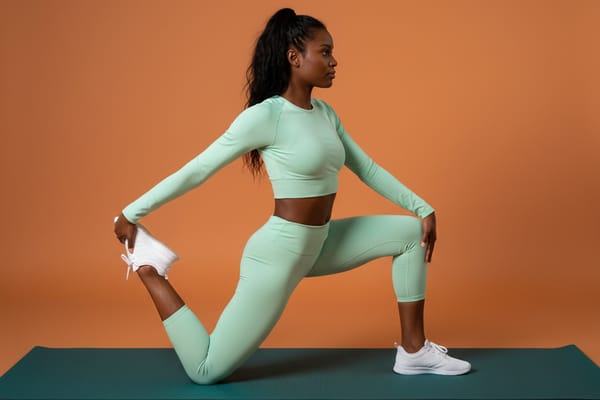
Why Tight Quads Matter
The quadriceps muscle group does more than straighten your knee. It influences hip position, knee tracking, and overall lower body mechanics. When quads are tight, several problems can develop:
Knee pain: Tight quads pull on the patella (kneecap), which can cause anterior knee pain, patellar tendinopathy, or patellofemoral syndrome. A 2017 study in the Journal of Orthopaedic & Sports Physical Therapy found that quadriceps tightness was associated with patellofemoral pain in runners.1
Hip flexor compensation: The rectus femoris (one of the four quad muscles) also flexes the hip. When tight, it can contribute to anterior pelvic tilt and lower back strain.
Reduced athletic performance: Limited quad flexibility restricts hip extension and knee flexion, affecting activities from sprinting to squatting.
Muscle imbalances: Tight quads often accompany weak hamstrings and glutes, creating movement dysfunction throughout the lower body.
Quad Anatomy Basics
The quadriceps femoris is actually four separate muscles that merge into a common tendon attaching to the kneecap:
Rectus Femoris: The only quad muscle that crosses both the hip and knee. It flexes the hip and extends the knee. This is the most commonly tight quad muscle because it shortens during sitting.
Vastus Lateralis: The largest quad muscle, located on the outer thigh. It extends the knee and helps stabilize the patella.
Vastus Medialis: Located on the inner thigh, this muscle is critical for the last few degrees of knee extension and patellar tracking.
Vastus Intermedius: Sits beneath the rectus femoris and extends the knee.
For stretching purposes, the rectus femoris requires special attention because of its two-joint function. To fully stretch it, you need both hip extension and knee flexion simultaneously.
Best Quad Stretches
Here are the most effective quad stretches, progressing from beginner-friendly to more advanced positions:
1. Standing Quad Stretch
What it targets: All four quad muscles, with emphasis on rectus femoris
This classic stretch is accessible anywhere and requires no equipment.
How to do it:
- Stand on one leg (use a wall or chair for balance if needed)
- Bend the other knee and grab your ankle behind you
- Pull your heel toward your glute while keeping your knees together
- Maintain a slight posterior pelvic tilt (tuck your tailbone under)
- Hold for 30-45 seconds per side
Key technique points:
- Keep your standing knee slightly bent to protect it
- Do not let the stretching knee drift forward past the standing leg
- Squeeze your glute on the stretching side to deepen the hip extension
Common mistake: Arching the lower back. This reduces the stretch on the rectus femoris and can strain the lumbar spine.
2. Lying Quad Stretch (Side-Lying)
What it targets: Quadriceps, hip flexors
This position allows for more relaxation and a longer, more comfortable hold.
How to do it:
- Lie on your side with legs stacked and extended
- Bend your top knee, drawing the heel toward your glute
- Grab your ankle with your top hand
- Gently pull the heel closer while pressing your hip forward
- Keep your thighs aligned
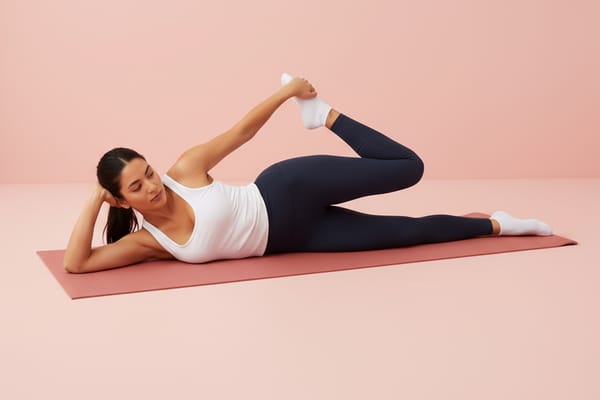
Key tip: Bend your bottom leg slightly for extra stability. Use a strap if you cannot comfortably reach your ankle.
3. Kneeling Quad Stretch (Couch Stretch)
What it targets: Rectus femoris, hip flexors, quadriceps
This is one of the most effective quad stretches because it combines maximum knee flexion with hip extension. The “couch stretch” variation (back foot elevated against a wall or couch) intensifies this further.
How to do it:
- Start in a half-kneeling position near a wall
- Slide your back knee toward the wall and place the top of your foot against it
- Bring your front foot forward into a lunge position
- Squeeze your glutes and keep your torso upright
- Hold for 30-60 seconds per side
Progression: Start with just the basic kneeling position before adding the wall. The full couch stretch is intense and should be approached gradually.
4. Prone Quad Stretch
What it targets: Quadriceps
A simple, relaxed position that works well for beginners or as a gentle option.
How to do it:
- Lie face down with legs extended
- Bend one knee and reach back to grab your ankle
- Gently pull your heel toward your glute
- Keep your hips pressed into the floor
Key tip: If you feel lower back discomfort, place a small pillow under your hips.
5. Kneeling Lunge with Quad Focus
What it targets: Hip flexors, rectus femoris, quadriceps
This stretch combines the hip flexor stretch with a quad component.
How to do it:
- Start in a half-kneeling lunge position
- Reach back with your rear-side hand and grab your ankle
- Draw your heel toward your glute while pressing your hips forward
- Keep your torso upright
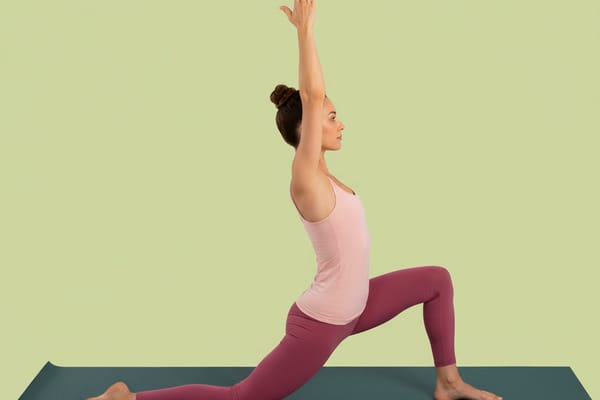
Find this in: Our Hip Flexibility Foundation routine includes this stretch with proper progression.
Dynamic Quad Stretches
Dynamic stretches work well as part of a warm-up before running, cycling, or leg workouts.
Walking Quad Pull
Pull your heel to your glute while taking a step forward, then release and switch legs. Continue for 10-12 reps per side.
Leg Swings (Forward/Back)
Swing your leg forward and back in a controlled manner to dynamically stretch both the quads (on the back swing) and hamstrings (on the forward swing).
Butt Kicks
A classic running warm-up that dynamically stretches the quads through repeated knee flexion.
Quad Stretches for Different Activities
For Runners
Runners often develop tight quads from the repetitive knee flexion and extension of the gait cycle. A 2019 study in the Journal of Sports Sciences found that dynamic stretching before running and static stretching after improved flexibility without impairing performance.2
Recommended approach:
- Before running: Dynamic stretches (walking quad pulls, butt kicks) for 5 minutes
- After running: Static stretches (standing, lying, or kneeling) held for 45-60 seconds per side
Our Hamstring Stretches for Runners article covers the complementary posterior chain work.
For Cyclists
Cycling keeps the hip flexed and knee bent through most of the pedal stroke, which can significantly shorten the quads and hip flexors over time.
Recommended approach:
- Focus on stretches that combine hip extension with knee flexion (kneeling quad, couch stretch)
- Include hip flexor stretches to address the psoas
- Stretch after every ride, even if briefly
For Desk Workers
Sitting keeps your knees bent and hips flexed for hours, shortening both the quads and hip flexors. This contributes to anterior pelvic tilt and lower back strain.
Recommended approach:
- Take movement breaks every 30-60 minutes
- Include standing quad stretches that can be done at your desk
- Add the couch stretch to your evening routine
Our Stretching for Desk Workers guide provides a comprehensive approach.
How Often Should I Stretch My Quads?
Research supports daily stretching for flexibility improvement. A 2021 systematic review found that stretching performed at least 5 days per week was more effective than less frequent practice.3
For maintenance: 30-45 seconds per side, once daily For improvement: 60-90 seconds per side, 5-7 days per week After intense exercise: 45-60 seconds per side
Static vs. Dynamic: Which Is Better?
Both have their place:
Dynamic stretches (movement-based) are best before activity. They increase blood flow, warm up the muscles, and prepare the nervous system for exercise without reducing muscle power output.
Static stretches (held positions) are best after activity or as a standalone flexibility session. They promote lasting flexibility gains when held for adequate duration.
A 2016 meta-analysis in the British Journal of Sports Medicine found that static stretching before exercise could temporarily reduce strength and power, while dynamic stretching had no negative effect.4 This is why dynamic stretches work better as warm-ups.
Common Quad Stretching Mistakes
Mistake 1: Arching the Lower Back
Leaning back or arching the lumbar spine during standing quad stretches reduces the stretch on the rectus femoris and can strain the lower back. Maintain a neutral spine or slight posterior pelvic tilt.
Mistake 2: Letting the Knee Drift Forward
In standing stretches, the stretching knee should stay aligned with or slightly behind the standing leg. Letting it drift forward reduces the stretch and can stress the knee joint.
Mistake 3: Holding the Foot Instead of the Ankle
Pulling on your foot can hyperextend the ankle joint. Grab at the ankle or top of the foot instead for a more comfortable hold.
Mistake 4: Bouncing
Ballistic stretching (bouncing) can trigger the stretch reflex and actually increase muscle tension. Use slow, steady pressure instead.
Mistake 5: Stretching Cold Muscles
Stretching completely cold muscles increases injury risk. A few minutes of light movement (walking, gentle bodyweight squats) warms the tissue before intense stretching.
Strengthening Alongside Stretching
Flexibility without strength creates instability. Research shows that combining stretching with strengthening produces better long-term outcomes than stretching alone.5
For the quads, useful strengthening exercises include:
- Squats and lunges (through full range of motion)
- Step-ups
- Terminal knee extensions (for the vastus medialis)
- Single-leg movements for balance
Frequently Asked Questions
Can tight quads cause knee pain?
Yes. Tight quadriceps increase tension on the patellar tendon and can alter how the kneecap tracks in its groove. This contributes to anterior knee pain, patellar tendinopathy, and patellofemoral syndrome.
How long does it take to loosen tight quads?
Most people notice improvement within 2-3 weeks of consistent daily stretching. Significant flexibility gains typically take 6-8 weeks of regular practice.
Should I stretch before or after working out?
Use dynamic stretches before working out to warm up without reducing muscle power. Save static stretches for after your workout when muscles are warm and pliable.
Can I stretch my quads every day?
Yes. Daily quad stretching is safe and effective for most people. If you experience soreness or discomfort, reduce the intensity or frequency.
Why are my quads always tight even though I stretch?
Several possibilities:
- Inconsistent practice (flexibility gains require regular reinforcement)
- Not holding stretches long enough (aim for 45-60 seconds minimum)
- The tightness may be related to weakness rather than true shortness
- Other structures (hip flexors, IT band) may be contributing to perceived tightness
Which quad stretch is most effective?
The kneeling quad stretch (couch stretch variation) is generally considered most effective because it maximizes both hip extension and knee flexion, fully lengthening the rectus femoris. However, it is also the most intense, so beginners should start with standing or lying variations.
Building a Quad Stretching Routine
Basic Routine (5 minutes)
Suitable for daily maintenance or post-workout:
- Standing quad stretch: 30 seconds each side
- Lying quad stretch: 30 seconds each side
- Optional: Kneeling lunge with quad focus: 30 seconds each side
Intermediate Routine (10 minutes)
For those seeking flexibility improvement:
- Walking quad pulls (warm-up): 10 reps each side
- Standing quad stretch: 45 seconds each side
- Lying quad stretch: 45 seconds each side
- Kneeling quad stretch: 60 seconds each side
Advanced Routine (15 minutes)
For dedicated flexibility work:
- Dynamic warm-up: 2-3 minutes
- Standing quad stretch: 45 seconds each side
- Lying quad stretch: 60 seconds each side
- Couch stretch (wall-assisted): 90 seconds each side
- Kneeling lunge with quad focus: 60 seconds each side
Key Takeaways
- Tight quads affect more than just your thighs: They contribute to knee pain, hip issues, and lower back strain
- The rectus femoris is the key target: It crosses both hip and knee, requiring stretches that extend the hip while flexing the knee
- Consistency matters more than intensity: Daily stretching for 30-45 seconds beats occasional intense sessions
- Dynamic before, static after: Use movement-based stretches as warm-ups and holds for flexibility gains
- Combine stretching with strengthening: Flexibility without strength creates instability
Related Articles
- The Complete Hip Flexibility Guide
- Why Your Hip Flexors Are Always Tight
- IT Band Stretches: How to Relieve Tightness
References
Willy RW, Hoglund LT, Barton CJ, et al. (2019). Patellofemoral Pain: Clinical Practice Guidelines Linked to the International Classification of Functioning, Disability and Health. Journal of Orthopaedic & Sports Physical Therapy, 49(9), CPG1-CPG95. PubMed ↩︎
Opplert J, Babault N. (2018). Acute Effects of Dynamic Stretching on Muscle Flexibility and Performance: An Analysis of the Current Literature. Sports Medicine, 48(2), 299-325. PubMed ↩︎
Thomas E, Bianco A, Paoli A, Palma A. (2018). The Relation Between Stretching Typology and Stretching Duration: The Effects on Range of Motion. International Journal of Sports Medicine, 39(4), 243-254. PubMed ↩︎
Behm DG, Blazevich AJ, Kay AD, McHugh M. (2016). Acute effects of muscle stretching on physical performance, range of motion, and injury incidence in healthy active individuals: a systematic review. Applied Physiology, Nutrition, and Metabolism, 41(1), 1-11. PubMed ↩︎
Afonso J, Ramirez-Campillo R, Moscao J, et al. (2021). Strength Training versus Stretching for Improving Range of Motion: A Systematic Review and Meta-Analysis. Healthcare, 9(4), 427. PubMed ↩︎
