The shoulder is the most mobile joint in the human body, capable of moving through an extraordinary range of motion in multiple planes. This mobility comes at a cost: the shoulder sacrifices stability for freedom, making it vulnerable to dysfunction and restriction.
Poor shoulder mobility affects more than just reaching overhead. It limits athletic performance, creates compensatory movement patterns that stress other joints, and can lead to pain in the neck, upper back, and even lower back.
This comprehensive guide covers everything you need to know about shoulder mobility: the underlying anatomy, how to assess your current mobility, and proven exercises to restore and maintain full range of motion.
Understanding Shoulder Anatomy
The shoulder is not a single joint but a complex of four articulations working together.
The Glenohumeral Joint
The primary shoulder joint where the humerus (upper arm bone) meets the scapula (shoulder blade). Unlike the deep socket of the hip joint, the shoulder socket (glenoid fossa) is shallow, providing minimal bony constraint. Stability comes primarily from soft tissues: the joint capsule, ligaments, rotator cuff muscles, and labrum (a fibrocartilage rim that deepens the socket).
This design allows tremendous mobility but requires healthy soft tissues to function properly. When these tissues become tight, scarred, or weak, mobility suffers.
The Scapulothoracic Joint
Not a true joint but a critical functional articulation where the scapula glides on the ribcage. The scapula must move freely for the shoulder to achieve full range of motion. When scapular movement becomes restricted, the glenohumeral joint cannot compensate, limiting overhead reach and rotation.
Research has demonstrated that scapular dysfunction is present in up to 68-100% of shoulder injuries, highlighting its importance.1
The Acromioclavicular (AC) Joint
Where the collarbone (clavicle) meets the acromion of the scapula. This small joint allows the scapula to rotate during overhead movements. Stiffness here limits scapular motion and consequently shoulder mobility.
The Sternoclavicular (SC) Joint
Where the clavicle meets the sternum. This is the only bony connection between the arm and the trunk. Movement here is subtle but essential for full shoulder function.
The Rotator Cuff
Four muscles (supraspinatus, infraspinatus, teres minor, subscapularis) that originate on the scapula and attach to the humerus. Beyond rotating the arm, they center the humeral head in the socket during movement. Rotator cuff weakness or tightness directly impacts shoulder mobility and function.
Key Muscles Affecting Shoulder Mobility
Commonly Tight:
- Pectoralis major and minor (chest)
- Latissimus dorsi (lats)
- Teres major
- Upper trapezius
- Levator scapulae
- Subscapularis (internal rotator)
Commonly Weak:
- Lower trapezius
- Serratus anterior
- External rotators (infraspinatus, teres minor)
- Deep cervical flexors
This pattern of tightness and weakness—known as upper crossed syndrome—is extremely common in modern populations and significantly restricts shoulder mobility.2
Assessing Your Shoulder Mobility
Before starting a mobility program, assess your current status. These tests identify specific restrictions.
Wall Arm Raise Test
How to test: Stand with back, glutes, and head against a wall. Raise arms overhead, keeping elbows straight and trying to touch thumbs to the wall.
Ideal result: Thumbs touch wall while maintaining back contact
Common restrictions:
- Lower back arches away from wall (compensation for lat/teres tightness)
- Elbows bend (shoulder flexion restriction)
- Arms cannot reach wall (posterior capsule or lat tightness)
Scratch Test (Apley’s)
How to test: Reach one hand behind your back from below (as if scratching your back). Reach the other hand behind from above (over the shoulder). Try to touch fingertips.
Ideal result: Fingertips touch or overlap
What restrictions indicate:
- Bottom hand limited: Internal rotation and extension restriction
- Top hand limited: External rotation and flexion restriction
- Significant asymmetry: Unilateral capsular or muscular restriction
External Rotation at 90 Degrees
How to test: Lie on your back with arm at 90 degrees from body, elbow bent 90 degrees. Let forearm fall back toward floor.
Ideal result: Forearm reaches parallel to floor or beyond
Common restrictions:
- Internal rotators (subscapularis, pec, lat) tightness
- Posterior capsule tightness limiting the compensatory anterior translation
Internal Rotation Assessment
How to test: Same position as above, but rotate forearm forward toward floor.
Ideal result: Forearm reaches parallel to floor
Common restrictions:
- External rotator tightness
- Posterior capsule restriction
Scapular Wall Slides
How to test: Stand with back against wall. Press backs of hands, elbows, and shoulders against wall. Slide arms up and down while maintaining contact.
What it reveals:
- Inability to maintain contact indicates thoracic kyphosis or scapular dysfunction
- Pain or pinching suggests impingement issues
- Asymmetry indicates unilateral restrictions
Why Shoulder Mobility Declines
Understanding the causes helps address root issues, not just symptoms.
Prolonged Poor Posture
Sitting with rounded shoulders causes:
- Chest muscles to shorten chronically
- Thoracic spine to stiffen in kyphosis
- Scapulae to move forward and tilt anteriorly
- Upper trapezius to become overworked while lower trapezius weakens
This postural pattern, repeated daily for years, progressively restricts mobility.
Repetitive Movement Patterns
Using the shoulder in limited patterns (always reaching forward for a keyboard, for example) reinforces certain movement pathways while neglecting others. The shoulder loses the ability to move in neglected directions.
Previous Injury
Shoulder injuries often heal with scar tissue formation in the joint capsule and surrounding muscles. Without specific rehabilitation, this scar tissue permanently limits range of motion.
Research published in Physical Therapy in Sport found that even minor shoulder injuries can lead to lasting mobility deficits if not properly rehabilitated.
Aging
Age-related changes include decreased collagen elasticity, reduced joint fluid viscosity, and degenerative changes in cartilage and bone. While some decline is normal, proactive mobility work significantly slows this process.
Thoracic Spine Stiffness
The thoracic spine must extend and rotate for the shoulder to achieve full overhead motion. A stiff thoracic spine forces compensations at the shoulder and lumbar spine.
Breathing Dysfunction
Dysfunctional breathing patterns (chest breathing rather than diaphragmatic) create chronic tension in accessory breathing muscles of the neck and chest, restricting shoulder mobility.
Stretches for Shoulder Mobility
These stretches target the muscles and tissues most commonly restricting shoulder mobility.
Doorway Pec Stretch
Target: Pectoralis major and minor
How to do it:
- Stand in doorway with forearm on frame at 90 degrees
- Step forward through doorway until stretch is felt in chest
- Hold 45-60 seconds
- Repeat with arm at different heights (45 degrees, 90 degrees, 135 degrees) to target different pec fibers
Why it helps: Opens the anterior shoulder and chest, allowing the shoulder to sit in a more neutral position.
Sleeper Stretch
Target: Posterior capsule
How to do it:
- Lie on side with affected shoulder down
- Bottom arm at 90 degrees from body, elbow bent 90 degrees
- Use top hand to push bottom forearm toward floor
- Hold 30-45 seconds
Important: This is a gentle stretch. Pushing too hard can aggravate shoulder issues. The stretch sensation should be mild.
Why it helps: The posterior capsule commonly becomes tight in overhead athletes and desk workers, limiting internal rotation and creating abnormal mechanics.
Lat Stretch
Target: Latissimus dorsi
How to do it:
- Kneel facing a bench or elevated surface
- Place elbows on surface, hands together
- Sit back and drop chest toward floor
- Hold 45-60 seconds
Variation: Side-lying lat stretch—lie on side with bottom arm extended overhead, pull top knee toward chest while reaching bottom arm long.
Why it helps: Tight lats restrict overhead reaching and external rotation.
Cross-Body Stretch
Target: Posterior deltoid, infraspinatus
How to do it:
- Bring right arm across body at shoulder height
- Use left hand to pull right arm closer
- Keep right shoulder down
- Hold 30-45 seconds each side
Why it helps: Addresses posterior shoulder tightness that limits internal rotation and horizontal adduction.
Thread the Needle
Target: Thoracic rotation, posterior shoulder
How to do it:
- Start on hands and knees
- Reach right arm under body to the left
- Let shoulder and head rest on floor
- Hold 30-45 seconds each side
Why it helps: Improves thoracic rotation, which is essential for shoulder function, while stretching the posterior shoulder.
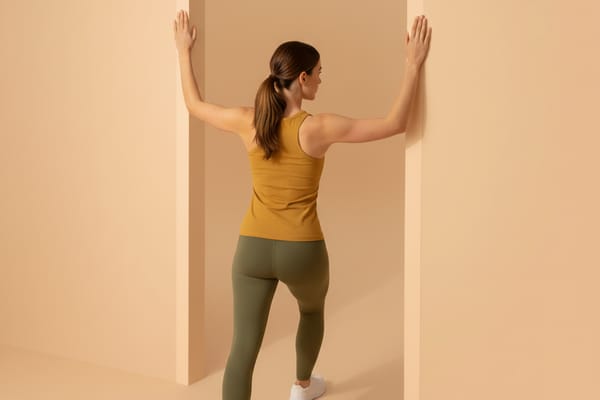
Corner Stretch
Target: Pectoralis major and minor bilaterally
How to do it:
- Stand facing a corner
- Place forearms on each wall, elbows at shoulder height
- Lean body into corner until stretch is felt in chest
- Hold 45-60 seconds
Why it helps: Opens both sides simultaneously and stretches pec minor, which when tight causes scapular anterior tilt.
Prone Floor Angels
Target: External rotators, upper back
How to do it:
- Lie face down with arms in goalpost position
- Squeeze shoulder blades together
- Slowly slide arms overhead while maintaining position
- Return to start
- Perform 10-15 repetitions
Why it helps: This is both a stretch and strengthening exercise, improving external rotation mobility while building strength in the position.
Mobility Exercises for the Shoulder
Beyond static stretching, these exercises improve active range of motion.
Wall Slides
Purpose: Improve scapular mechanics and overhead mobility
How to do it:
- Stand with back against wall
- Place hands and elbows against wall in W position
- Slide arms up into Y position while maintaining wall contact
- Slide back to W
- Perform 15-20 repetitions
Progression: Add band resistance as mobility improves
Controlled Articular Rotations (CARs)
Purpose: Maintain and explore full joint range
How to do it:
- Stand with arm at side
- Make a fist and create tension throughout arm
- Slowly trace the largest possible circle with arm
- Move through flexion, abduction, extension while rotating
- 3-5 circles each direction
Why it works: CARs actively explore joint boundaries, sending neurological input that helps maintain range. Research supports controlled rotational movements for joint health.
Banded Pull-Aparts
Purpose: Strengthen posterior shoulder while improving mobility
How to do it:
- Hold resistance band with arms extended in front
- Pull band apart by squeezing shoulder blades and externally rotating
- Control return
- Perform 15-20 repetitions
Why it works: Strengthens the commonly weak posterior shoulder muscles that balance anterior tightness.
Shoulder Dislocations (with stick or band)
Purpose: Improve overhead and behind-back mobility
How to do it:
- Hold stick or band wider than shoulder width
- With straight arms, rotate stick from front of body to behind body
- Return to front
- Perform 10-15 repetitions
- Narrow grip as mobility improves
Important: “Dislocation” is just the exercise name—this should not cause pain. If it does, use a wider grip or reduce range.
Prone Y-T-W-L
Purpose: Activate lower trapezius and scapular stabilizers
How to do it:
- Lie face down on floor or bench
- Extend arms into Y position (thumbs up), hold 5 seconds
- Move to T position, hold 5 seconds
- Move to W position, hold 5 seconds
- Move to L position (elbows at 90°), hold 5 seconds
- Perform 5-8 complete cycles
Why it works: Systematically activates the muscles that stabilize the scapula and support healthy shoulder mechanics.3
Open Books
Purpose: Thoracic rotation
How to do it:
- Lie on side with knees stacked and bent
- Extend both arms in front at shoulder height
- Rotate top arm open toward floor behind you
- Follow with eyes
- Return
- Perform 10-12 each side
Why it works: Improves thoracic rotation that is essential for full shoulder function.
Our Shoulder Mobility Builder and Shoulder Deep Release routines incorporate these exercises into comprehensive sessions.
Programming for Results
Improving shoulder mobility requires consistent, strategic practice.
Daily Maintenance (5-10 minutes)
Perform daily for ongoing shoulder health:
- Shoulder CARs: 3-5 each direction
- Wall slides: 15 repetitions
- Doorway pec stretch: 30 seconds each side
- Cross-body stretch: 30 seconds each side
Focused Mobility Session (20-30 minutes, 3x/week)
For significant improvement:
- Foam roll thoracic spine: 2 minutes
- Thread the needle: 45 seconds each side
- Open books: 10 each side
- Doorway pec stretch: 60 seconds each position
- Sleeper stretch: 45 seconds each side
- Lat stretch: 60 seconds
- Shoulder CARs: 5 each direction
- Prone Y-T-W-L: 8 cycles
- Wall slides: 20 repetitions
- Band pull-aparts: 20 repetitions
Pre-Training (5 minutes)
Before workouts involving the shoulders:
- Arm circles: 10 each direction
- Shoulder CARs: 3 each direction
- Band pull-aparts: 15 repetitions
- Shoulder dislocations: 10 repetitions
- Relevant dynamic movements for workout ahead
Addressing Common Shoulder Issues
Rounded Shoulders
Priority stretches: Doorway pec stretch (especially at lower arm angles), corner stretch, prone extension exercises
Priority strengthening: Face pulls, band pull-aparts, prone Y-T-W-L, rows
Root cause: Address sitting posture, workstation ergonomics
Limited Overhead Reach
Priority stretches: Lat stretch, thoracic spine mobility, pec minor release
Priority exercises: Wall slides, shoulder CARs emphasizing overhead motion, overhead shrugs
Consider: Thoracic spine often limits overhead reach more than the shoulder itself
Internal Rotation Deficit
Priority stretches: Sleeper stretch (gentle), cross-body stretch
Priority exercises: Internal rotation with band, CARs emphasizing internal rotation
Caution: Internal rotation restrictions sometimes develop protectively after injury. If stretching causes pain, consult a professional.
External Rotation Deficit
Priority stretches: Pec stretch, lat stretch, subscapularis release with lacrosse ball
Priority exercises: External rotation with band at various angles, side-lying external rotation
Impingement Symptoms
Approach: Focus on scapular stability before aggressive mobility work. Strengthen lower trapezius, serratus anterior. Avoid painful positions while building supporting strength. Consult a professional for persistent symptoms.
Timeline for Improvement
With consistent practice:
Week 1-2: Temporary improvements after sessions. May feel some soreness as tissues adapt.
Week 3-4: More lasting changes begin. End range positions feel more accessible.
Week 5-8: Noticeable functional improvements. Overhead reach easier. Daily tasks less restricted.
Month 3+: Significant mobility gains that feel stable. Maintenance work sustains improvements.
Individual results vary based on severity of restriction, consistency of practice, and underlying causes.
Common Mistakes
Stretching through pain: Shoulder stretches should create a pull sensation, not pain. Pain indicates something is wrong—modify or skip that stretch.
Ignoring the thoracic spine: Many shoulder mobility issues originate in the thoracic spine. Include thoracic work in any shoulder mobility program.
Only stretching, never strengthening: Flexibility without strength creates instability. Always balance stretching with strengthening work for the posterior shoulder.
Expecting fast results: Chronic restrictions took years to develop. Significant improvement takes weeks to months.
Inconsistent practice: Sporadic effort produces minimal results. Brief daily practice outperforms occasional longer sessions.
Key Takeaways
- The shoulder is complex: Four articulations, multiple muscles, and interdependent structures require comprehensive approaches
- Assess before addressing: Identify your specific restrictions rather than following generic programs
- Common patterns exist: Anterior tightness with posterior weakness affects most people; address both
- Thoracic spine matters: Often limits shoulder mobility more than the shoulder itself
- Balance stretching and strengthening: Mobility without stability is problematic
- Consistency is essential: Daily brief practice produces better results than occasional longer sessions
Related Articles
- Posture Exercises: Fix Rounded Shoulders and Forward Head
- Tech Neck: Causes, Symptoms, and Stretches
- Neck Pain and Stretching: The Complete Guide
- Stretching for Desk Workers
- Chest Stretches: How to Open Up Tight Pecs
References
Kibler WB, Ludewig PM, McClure PW, et al. (2013). Clinical implications of scapular dyskinesis in shoulder injury: The 2013 consensus statement from the Scapular Summit. British Journal of Sports Medicine, 47(14), 877-885. PubMed ↩︎
Kibler WB, Sciascia A, Wilkes T. (2012). Scapular dyskinesis and its relation to shoulder injury. Journal of the American Academy of Orthopaedic Surgeons, 20(6), 364-372. PubMed ↩︎
Cools AMJ, Struyf F, De Mey K, et al. (2013). Rehabilitation of scapular dyskinesis: from the office worker to the elite overhead athlete. British Journal of Sports Medicine, 48(8), 692-697. PubMed ↩︎
