Knee pain is one of the most common joint complaints in the world. It affects runners, office workers, athletes, and people who simply go about daily life. Roughly one in four adults will deal with significant knee pain at some point, and the numbers keep rising as populations age and activity patterns shift.
Here is the thing most people miss: knee pain is rarely about the knee itself. The knee is a hinge joint stuck between two powerful and complex joints (the hip above and the ankle below). When muscles around those joints get tight, weak, or imbalanced, the knee absorbs the consequences. Tight quads pull on the kneecap. Stiff hamstrings alter how the joint tracks. Weak glutes let the knee collapse inward. The knee is often the victim, not the cause.
That is why stretching and targeted exercises can be so effective for many types of knee pain. By addressing the muscular imbalances that create stress at the knee joint, you treat the root problem rather than just managing symptoms.
This guide covers the most common causes of knee pain, explains which stretches address each one, walks through the most effective exercises in detail, and provides a framework for building a recovery and prevention practice.
Why Stretching Helps Knee Pain
The knee joint relies entirely on the muscles, tendons, and ligaments around it for stability and proper movement. Unlike the hip (a deep ball-and-socket joint) or the ankle (supported by a bony mortise), the knee has relatively little bony stability. It depends on soft tissue balance.
When everything works well, the kneecap tracks smoothly in its groove, forces are distributed evenly across the joint surfaces, and movement feels effortless. When things go wrong, the picture changes quickly.
Tight quadriceps increase compression on the kneecap. The rectus femoris, which crosses both the hip and knee, is particularly problematic when shortened. It pulls the kneecap into the femoral groove with excessive force, especially during stairs, squatting, or running.
Tight hamstrings restrict knee extension, forcing the joint to work through a limited range. They can also increase the compressive load on the back of the knee during straightening movements.
Tight calves limit ankle dorsiflexion (the ability to bring your toes toward your shin). When the ankle cannot bend enough, the knee compensates by shifting forward or collapsing inward during walking, running, and squatting.
Weak or inhibited glutes allow the knee to drift inward during weight-bearing activities. This valgus pattern is one of the most well-documented risk factors for knee injuries and patellofemoral pain.
Tight hip flexors and IT band alter the way forces travel through the leg. A stiff iliotibial band pulls laterally on the kneecap and can create friction where it crosses the outside of the knee.
Stretching addresses the tightness component of these imbalances. Combined with strengthening (particularly for the glutes and VMO), it helps restore the muscular balance the knee needs to function without pain.
What Research Says
The evidence supporting stretching and exercise for knee pain is substantial, particularly for the most common conditions.
A 2019 systematic review in the Journal of Orthopaedic and Sports Physical Therapy found that exercise therapy (including stretching) was effective for reducing pain and improving function in patients with patellofemoral pain syndrome. The review noted that programs combining hip and knee exercises produced better outcomes than knee exercises alone.1
Research published in the British Journal of Sports Medicine showed that quadriceps stretching combined with strengthening reduced anterior knee pain by an average of 43% over 6 weeks in patients with patellofemoral pain.2
A 2020 Cochrane review on exercise for knee osteoarthritis concluded that “therapeutic exercise provides short-term benefit that is sustained for at least two to six months after cessation of formal treatment.” The review analyzed 54 studies covering over 8,000 participants.3
A study in the American Journal of Sports Medicine demonstrated that hip strengthening programs reduced runner’s knee symptoms in 93% of participants who had previously failed to improve with traditional quadriceps-focused rehabilitation alone.4
Research in the Journal of Athletic Training found that limited ankle dorsiflexion (often caused by tight calves) was significantly associated with patellar tendinopathy in jumping athletes. Calf stretching improved ankle mobility and reduced tendon loading patterns.5
The pattern across the literature is clear: stretching and strengthening the muscles surrounding the knee produces meaningful improvements in pain and function for most common knee conditions.
Common Causes of Knee Pain and Which Stretches Help
Not all knee pain is the same. Understanding your specific condition helps you choose the right stretches and set realistic expectations.
Patellofemoral Pain (Runner’s Knee)
The most common cause of anterior (front) knee pain. It results from abnormal tracking of the kneecap in its groove on the femur. You typically feel a dull ache behind or around the kneecap that worsens with stairs, squatting, prolonged sitting, or running.
Contributing factors include tight quads (particularly rectus femoris and vastus lateralis), weak glutes allowing the knee to collapse inward, and tight hip flexors pulling the pelvis forward.
Stretching potential: High. This condition responds well to a combination of quad stretching, hip flexor stretching, IT band work, and glute strengthening. Most effective stretches: standing quad, lying quad, kneeling psoas, pigeon pose.
IT Band Syndrome
Pain on the outside of the knee, typically felt during or after running. The iliotibial band, a thick band of fascia running from the hip to the outside of the knee, creates friction at the lateral femoral condyle during repetitive bending and straightening.
Contributing factors include weak hip abductors (glute medius), tight hip flexors, and training errors (sudden mileage increases).
Stretching potential: Moderate. The IT band itself does not stretch much because it is fascia, not muscle. However, stretching the muscles that feed into it (TFL, glutes) and addressing hip muscle imbalances helps significantly. Most effective stretches: pigeon, seated figure four, kneeling psoas. Foam rolling the lateral quad can also provide relief. See our complete IT Band Stretches Guide for detailed techniques.
Patellar Tendinitis
Pain at the bottom of the kneecap where the patellar tendon attaches. Common in jumping sports (sometimes called “jumper’s knee”). The tendon becomes irritated from repeated loading, especially during explosive movements.
Contributing factors include tight quads, limited ankle dorsiflexion, and inadequate eccentric strength in the quadriceps.
Stretching potential: Moderate. Quad and calf stretching reduce the load on the patellar tendon. However, eccentric strengthening exercises are the primary evidence-based treatment. Most effective stretches: standing quad, kneeling quad, leaning calf.
Knee Osteoarthritis
Gradual wearing of the cartilage surfaces within the knee joint. Causes stiffness, aching, and sometimes swelling. Worse in the morning or after prolonged inactivity. More common after age 50 but can begin earlier, especially after knee injuries.
Contributing factors include age, previous injury, excess body weight, muscle weakness, and reduced joint range of motion.
Stretching potential: High for symptom management. Research consistently shows that exercise programs including stretching improve pain and function in knee osteoarthritis. Gentle, consistent stretching maintains range of motion and reduces stiffness. Most effective stretches: lying quad, lying hamstring, leaning calf, butterfly.
Meniscus Issues
The menisci are C-shaped cartilage pads that cushion the knee. Tears can result from trauma (twisting on a planted foot) or gradual degeneration. Symptoms include catching, locking, clicking, swelling, and pain along the joint line.
Stretching potential: Low to moderate. Stretching cannot heal a meniscus tear, but maintaining flexibility in the surrounding muscles reduces compensatory stress on the joint and supports recovery. If you have a known meniscus tear, work with a physical therapist to determine which stretches are appropriate. Avoid deep knee bending positions that may aggravate the tear.
The Most Effective Stretches for Knee Pain
These stretches target the key muscle groups that influence knee health. Start gently, particularly if you are currently experiencing pain, and progress gradually.
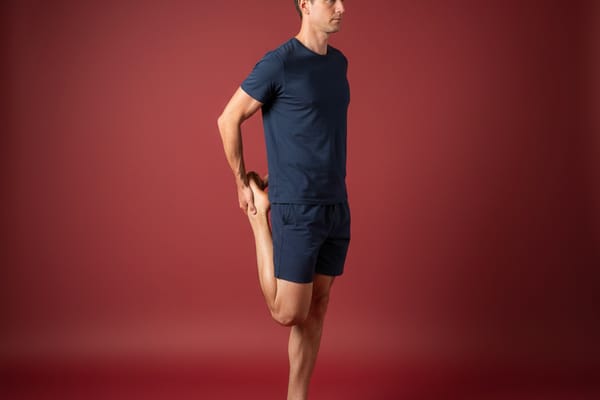
1. Standing Quad Stretch
What it targets: Quadriceps, particularly the rectus femoris.
Why it helps the knee: Reduces tension on the kneecap and decreases compressive forces in the patellofemoral joint. This is the single most commonly recommended stretch for anterior knee pain.
How to do it: Stand on one leg (hold a wall for balance if needed). Bend the other knee and grab your ankle or foot behind you. Pull your heel gently toward your glute. Keep your knees close together and your standing leg slightly bent. Hold for 30-60 seconds per side.
Key point: If grabbing your foot causes knee pain, loop a towel or strap around your ankle instead. The goal is a stretch in the front of your thigh, not pain in the knee.
Try this stretch in our Quad Relief Basics routine.
2. Lying Quad Stretch
What it targets: Quadriceps with emphasis on the rectus femoris in a more supported position.
Why it helps the knee: Provides a deep quad stretch without requiring balance. The lying position allows you to relax more fully into the stretch, which can produce greater muscle lengthening.
How to do it: Lie on your side. Bend your top knee and grab your ankle behind you, pulling your heel toward your glute. Keep your hips stacked and gently push your top hip forward to increase the stretch. Hold for 30-60 seconds per side.
Caution: If you have significant knee pain, bend only as far as comfortable. You should feel the stretch in the front of your thigh, not sharp pain in the knee joint.
3. Kneeling Quad Stretch
What it targets: Quadriceps and hip flexors simultaneously.
Why it helps the knee: Addresses the rectus femoris in both its roles (hip flexor and knee extensor) by combining hip extension with knee flexion. This is one of the most effective stretches for the rectus femoris.
How to do it: Start in a half-kneeling position with one foot forward and the other knee on a cushion or pad. Tuck your back toes and slowly shift your weight forward while keeping your torso upright. To intensify, reach back and grab the foot of your back leg, pulling your heel toward your glute.
Caution: If kneeling is painful, use extra padding under the knee or skip this stretch in favor of standing and lying variations. Never force your knee into a position that produces sharp pain.
4. Lying Hamstring Stretch
What it targets: Hamstrings (biceps femoris, semitendinosus, semimembranosus).
Why it helps the knee: Reduces posterior knee tightness, improves full knee extension, and decreases the compensatory load on the knee joint during walking and running.
How to do it: Lie on your back. Lift one leg toward the ceiling, keeping it as straight as comfortable. Hold the back of your thigh or calf (not behind the knee) and gently pull the leg toward you. Keep your opposite leg flat on the ground. Hold for 30-60 seconds per side.
Key point: A slight bend in the stretching knee is fine. Focus on feeling the stretch through the back of your thigh rather than forcing your leg perfectly straight.
This stretch features in our Hamstring Foundation Stretches routine.
5. Forward Fold
What it targets: Hamstrings, calves, and lower back.
Why it helps the knee: Stretches the entire posterior chain, improving flexibility in multiple structures that affect knee mechanics. Particularly useful for people whose knee pain is related to overall posterior tightness.
How to do it: Stand with feet hip-width apart. Hinge at the hips and fold forward, letting your head and arms hang. Keep a slight bend in your knees if your hamstrings are very tight. Let gravity do the work rather than forcing yourself deeper. Hold for 30-60 seconds.
Key point: This should feel like a comfortable, releasing stretch. If you feel strain behind the knees, bend them more. The stretch should be in the muscles, not the joint.
6. Leaning Calf Stretch
What it targets: Gastrocnemius and soleus (the two main calf muscles).
Why it helps the knee: Improves ankle dorsiflexion, which is critical for proper knee mechanics during walking, running, and squatting. Limited ankle mobility forces the knee to compensate, often by collapsing inward or shifting excessively forward.
How to do it: Stand facing a wall with one foot forward and one foot back. Keep your back heel on the ground and lean into the wall until you feel a stretch in your back calf. Hold for 30 seconds. Then bend the back knee slightly while keeping the heel down to shift the stretch to the soleus. Hold another 30 seconds. Switch sides.
Key point: Do both the straight-leg and bent-knee versions. The gastrocnemius (straight leg) and soleus (bent knee) need separate attention because they respond to different positions.
7. Pigeon Pose
What it targets: Deep external hip rotators (piriformis, obturator internus), glutes, and hip flexors of the back leg.
Why it helps the knee: Releases tightness in the muscles that control hip rotation and alignment. When these muscles are tight, they can alter the way forces travel through the leg, contributing to knee stress. Pigeon also stretches the hip flexors of the trailing leg.
How to do it: From a hands-and-knees position, bring your right knee forward and place it behind your right wrist. Angle your right shin as far toward parallel with the front of the mat as comfortable. Extend your left leg straight behind you. Lower your torso toward the floor. Hold for 60-90 seconds per side.
Caution: If you feel any pain in the front knee during this stretch, reduce the angle of the front shin. You can also place a cushion or block under your front hip for support.
8. Butterfly Stretch
What it targets: Inner thigh adductors and hip rotators.
Why it helps the knee: Tight adductors can alter knee tracking and contribute to medial (inner) knee stress. This stretch opens the hips and reduces pulling forces on the inside of the knee.
How to do it: Sit on the floor and bring the soles of your feet together, letting your knees fall outward. Hold your feet and sit tall. Gently press your knees toward the floor using your elbows or simply let gravity pull them down. Hold for 30-60 seconds.
Key point: Do not bounce your knees. Gentle, sustained pressure produces better results and is safer for the knee joint.
9. Kneeling Psoas Stretch
What it targets: Iliopsoas (psoas major and iliacus), the deepest hip flexor.
Why it helps the knee: A tight psoas tilts the pelvis forward (anterior pelvic tilt), which alters the alignment of the entire lower limb. This chain reaction increases stress at the knee. Releasing the psoas helps restore neutral pelvic alignment and reduces downstream knee loading.
How to do it: Start in a half-kneeling position with your right foot forward and left knee on a cushion. Tuck your pelvis under slightly (posterior tilt) and shift your weight forward. You should feel a deep stretch in the front of your left hip. Keep your torso tall throughout. Hold for 30-60 seconds per side.
Key point: The pelvic tuck is essential. Without it, you will stretch the rectus femoris but miss the deeper psoas. Think about flattening your lower back rather than arching it.
10. Seated Figure Four
What it targets: Piriformis, deep hip external rotators, and glutes.
Why it helps the knee: Releases tension in the muscles that control how the femur rotates in the hip socket. When these muscles are tight, the leg tends to rotate externally, which changes the angle at the knee and can contribute to lateral knee pain and IT band issues.
How to do it: Sit in a chair with both feet flat on the floor. Cross your right ankle over your left knee, creating a figure-four shape. Sit tall and gently lean forward from the hips until you feel a stretch in your right glute and outer hip. Hold for 30-60 seconds per side.
Key point: This is a great option for people who find floor-based hip stretches uncomfortable. You can adjust the intensity by varying how much you lean forward.
Strengthening Exercises That Support the Knee
Stretching alone is not enough for most knee conditions. The research consistently shows that combining flexibility work with targeted strengthening produces better outcomes. Stretching reduces tightness and restores range of motion, but strengthening builds the muscular support the knee needs for long-term health.
Here are four exercises that complement a knee-focused stretching routine:
Glute Bridges: Lie on your back with knees bent and feet flat. Push through your heels to lift your hips toward the ceiling. Squeeze your glutes at the top and lower slowly. Perform 2-3 sets of 12-15 repetitions. This strengthens the gluteus maximus, which is critical for proper hip and knee alignment.
Wall Sits: Stand with your back against a wall and slide down until your thighs are parallel to the floor (or as far as comfortable). Hold for 20-45 seconds. This builds isometric quad strength without the impact of squats or lunges, making it a safe option for many knee conditions.
Clamshells: Lie on your side with hips and knees bent at about 45 degrees. Keeping your feet together, lift your top knee as high as you can without rotating your pelvis. Lower slowly. Perform 2-3 sets of 15 per side. This targets the gluteus medius, which prevents the knee from collapsing inward.
Straight Leg Raises: Lie on your back with one knee bent and the other leg straight. Tighten the quad of the straight leg and lift it to the height of the opposite knee. Lower slowly. Perform 2-3 sets of 12-15 per side. This strengthens the quadriceps (particularly the VMO) without bending the knee, making it suitable even during acute knee pain.
Building a Knee Pain Recovery Practice
Recovery from knee pain is not a one-size-fits-all process. Your approach should match where you are in your recovery.
Acute Phase (Pain is frequent)
When your knee hurts most days or limits your daily activities, keep things gentle and simple.
Focus: Pain management and maintaining basic range of motion.
What to do: Choose 3-4 of the gentlest stretches from the list above (lying hamstring, standing quad with a strap, butterfly, seated figure four). Hold each for 20-30 seconds. Stretch 1-2 times per day. Add straight leg raises and clamshells if tolerated.
What to avoid: Deep knee bending, kneeling stretches, any position that reproduces sharp pain. This is not the time to push through discomfort.
Duration: Stay in this phase until pain consistently drops below 3/10 on most days.
Recovery Phase (Pain is decreasing)
Your pain is becoming more predictable and less frequent. Some days feel almost normal.
Focus: Gradually restoring flexibility and building strength.
What to do: Expand to 5-7 stretches. Increase hold times to 30-60 seconds. Add kneeling variations if tolerated. Begin wall sits and glute bridges. Stretch daily, perform strengthening exercises 3 times per week.
Try the Quad Relief Basics or Lower Body Flexibility Foundation routine during this phase.
What to avoid: Jumping back into high-impact activities too quickly. Progress should feel gradual, not aggressive.
Duration: Typically 4-8 weeks, depending on the severity of the original issue.
Prevention Phase (Ongoing maintenance)
Pain is rare or absent. You want to keep it that way.
Focus: Maintaining the flexibility and strength gains you have built.
What to do: Perform a comprehensive stretching routine 3-5 times per week. Include all major muscle groups around the knee: quads, hamstrings, calves, hip flexors, and glutes. Continue strengthening exercises 2-3 times per week. The Quad Flexibility Builder routine works well for maintenance.
Key principle: Consistency matters more than duration. A 10-minute daily routine provides more protection than a 45-minute session done once a week.
Common Mistakes
Stretching through sharp pain
Dull pulling sensations during stretching are normal. Sharp or stabbing pain is a warning sign. Pain in the joint itself (rather than the muscle) means you should modify the stretch or skip it entirely.
Fix: Use the “discomfort but not pain” rule. If you would rate the sensation above a 4/10, back off.
Ignoring the hip and ankle
Many people stretch only the muscles immediately around the knee (quads and hamstrings) and neglect the hip and ankle. Since the knee is influenced by joints above and below, this approach misses critical contributors.
Fix: Always include at least one hip stretch (pigeon, kneeling psoas, or seated figure four) and one calf stretch in your routine.
Bouncing into stretches
Ballistic stretching (bouncing at the end range) activates the stretch reflex, which actually tightens the muscle you are trying to lengthen. It also increases injury risk, especially around an already irritated knee.
Fix: Use slow, sustained holds. Ease into each stretch gradually and let the muscle release over 30-60 seconds.
Stretching without strengthening
Flexibility without strength leaves the joint unstable. If you stretch your quads without also building quad and glute strength, the knee may actually become less stable, not more.
Fix: Pair every stretching session with at least 5 minutes of strengthening work. Bridges, clamshells, wall sits, and straight leg raises take minimal time and provide significant benefit.
Expecting immediate results
Knee pain that developed over months or years will not resolve in a few days of stretching. Setting unrealistic timelines leads to frustration and abandonment.
Fix: Commit to a minimum of 4 weeks of consistent practice before evaluating whether your routine is working. Most people notice meaningful improvement within 2-6 weeks if they are addressing the right structures.
When to See a Professional
While stretching and exercise help most common knee conditions, some situations require professional evaluation. See a doctor or physical therapist if you experience:
- Locking or catching: The knee gets stuck in one position and will not bend or straighten, or you feel a clicking sensation with catching during movement.
- Giving way: The knee buckles or feels unstable during weight-bearing activities, as if it might collapse.
- Significant swelling: The knee becomes noticeably swollen within hours of an injury, or swelling persists for more than a few days without improvement.
- Inability to bear weight: You cannot put full weight on the affected leg or walking is severely limited.
- Pain at rest: Knee pain that persists even when you are not moving or that wakes you at night.
- No improvement after 4-6 weeks: If consistent stretching and strengthening have not reduced your symptoms, the diagnosis may need revisiting or your program may need professional adjustment.
These symptoms may indicate structural damage (ligament tears, significant meniscus injuries, or fractures) that stretching cannot address. Early evaluation leads to better outcomes for conditions that require medical intervention.
Frequently Asked Questions
Is it safe to stretch with knee pain?
For most common knee conditions, gentle stretching is safe and beneficial. The key is starting conservatively: use modified positions, shorter hold times, and low intensity. If a specific stretch reproduces your knee pain (pain in the joint, not just muscle stretch), skip that exercise and try an alternative that targets the same muscle group.
How long before stretching helps knee pain?
Most people notice some improvement within 1-2 weeks of consistent stretching. More substantial changes typically take 4-6 weeks. If you have been dealing with knee pain for years, expect a longer timeline. Research on patellofemoral pain shows that 6-12 week exercise programs produce the most reliable improvements.
Should I stretch before or after exercise?
For knee pain, stretching after exercise (when muscles are warm) tends to produce better results with less discomfort. Before exercise, gentle dynamic movements (leg swings, walking, bodyweight squats) are preferable to static stretching. Save the longer holds for your post-workout routine or dedicated stretching sessions.
Can stretching prevent knee injuries?
Flexibility is one component of injury prevention, but it is not the only one. Research suggests that combined programs (stretching plus strengthening plus proper training progression) are more effective at preventing knee injuries than stretching alone. That said, adequate quadriceps and hamstring flexibility appears to reduce the risk of several common knee conditions.
Is foam rolling good for knee pain?
Foam rolling can complement stretching by releasing tension in the quads, IT band area, and calves. It works best as a warm-up before stretching. Roll slowly over the muscles (not directly over the knee joint) for 30-60 seconds per area. If rolling reproduces your knee pain, reduce the pressure or skip that area.
Which is more important for knee pain: stretching or strengthening?
Both matter, and the research strongly supports combining them. If you had to choose one, strengthening (particularly glute and quad strengthening) has slightly more evidence behind it for most knee conditions. But the best results come from doing both. Stretching restores range of motion and reduces tension, while strengthening builds the support the knee needs.
Related Articles
- Quad Stretches: The Complete Guide
- IT Band Stretches: How to Relieve Tightness
- The Complete Hip Flexibility Guide
- The Complete Hamstring Flexibility Guide
- The Complete Calf Stretches and Ankle Mobility Guide
- Groin Stretches: The Complete Guide
References
Crossley KM, van Middelkoop M, Callaghan MJ, et al. (2016). 2016 Patellofemoral pain consensus statement from the 4th International Patellofemoral Pain Research Retreat. British Journal of Sports Medicine, 50(14), 839-843. PubMed ↩︎
Collins NJ, Barton CJ, van Middelkoop M, et al. (2018). 2018 Consensus statement on exercise therapy and physical interventions to treat patellofemoral pain. Journal of Orthopaedic and Sports Physical Therapy, 48(12), 877-886. PubMed ↩︎
Fransen M, McConnell S, Harmer AR, et al. (2015). Exercise for osteoarthritis of the knee: a Cochrane systematic review. British Journal of Sports Medicine, 49(24), 1554-1557. PubMed ↩︎
Ferber R, Bolgla L, Earl-Boehm JE, et al. (2015). Strengthening of the hip and core versus knee muscles for the treatment of patellofemoral pain: a multicenter randomized controlled trial. Journal of Athletic Training, 50(4), 366-377. PubMed ↩︎
Malliaras P, Cook J, Purdam C, Rio E. (2015). Patellar tendinopathy: clinical diagnosis, load management, and advice for challenging case presentations. Journal of Orthopaedic and Sports Physical Therapy, 45(11), 887-898. PubMed ↩︎
