Upper back stiffness is one of those problems that creeps up gradually. One day you notice a dull ache between your shoulder blades. You roll your shoulders, crack your back, and move on. Weeks later, the stiffness has become your new normal. Turning to check your blind spot while driving feels restricted. Reaching overhead requires effort. Your shoulders round forward without you realizing it.
The upper back (thoracic spine) is uniquely prone to stiffness because it is designed for stability rather than mobility, and modern life pushes it further into rigidity. Research on office workers found that upper back pain increased significantly over the course of an 8-hour workday, alongside measurable spinal compression.1 The good news: targeted stretching can reverse much of this stiffness.
This guide covers the anatomy behind upper back tightness, the best stretches to address it, and why thoracic mobility matters far more than most people realize.

Why Your Upper Back Gets Stiff
The Design of the Thoracic Spine
Your thoracic spine consists of 12 vertebrae, each attached to a pair of ribs. This rib attachment provides structural stability for protecting the heart and lungs, but it also limits how much each segment can move. While the lumbar spine (lower back) and cervical spine (neck) are built for mobility, the thoracic spine sacrifices movement for protection.
This means even a small reduction in thoracic mobility has noticeable effects. When these 12 segments each lose just a few degrees of movement, the cumulative restriction is substantial.
Desk Work and Screen Time
Sitting at a desk with arms forward creates a sustained flexion load on the thoracic spine. The upper back rounds, the chest collapses, and the head drifts forward. Over hours, days, and years, this position becomes the default.
A study measuring spinal changes during a full workday found that office workers experienced significant increases in upper back pain by end of day, along with spinal shrinkage from disc compression.1 The combination of sustained flexion and lack of extension movement is the primary driver of thoracic stiffness for most people.
Upper Crossed Syndrome
Upper crossed syndrome describes a predictable pattern of muscle imbalance: tight pectorals and upper trapezius combined with weak deep neck flexors and lower trapezius. This creates a characteristic rounded-shoulder, forward-head posture that locks the thoracic spine in flexion. Our posture exercises guide covers the full corrective approach for this pattern.
A 2024 meta-analysis of 22 studies confirmed that therapeutic exercises (including stretching) effectively reduce forward head posture, rounded shoulders, and thoracic kyphosis.2 The pattern is reversible with consistent targeted work.
The Shoulder Connection
Here is where thoracic mobility becomes especially important. Your shoulders depend on thoracic spine positioning to function properly. When the upper back rounds, the shoulder blades tilt forward and the subacromial space narrows. This restricts overhead movement and increases impingement risk.
Research found that individuals with shoulder impingement had significantly greater thoracic kyphosis (6.2 degrees more) and 7.8 degrees less active thoracic extension compared to healthy controls.3 A separate systematic review confirmed that maximum shoulder range of motion is significantly greater in erect postures compared to slouched postures.4
In other words, fixing your upper back mobility directly improves shoulder function.
The Best Upper Back Stretches
These stretches address thoracic extension, rotation, and lateral flexion, the three planes of motion that become restricted.
Cat-Cow
The simplest and most accessible thoracic mobility exercise. Cat-cow moves the spine through flexion and extension rhythmically, increasing segmental mobility.
How to do it:
- Start on hands and knees, wrists under shoulders, knees under hips
- Inhale: drop the belly, lift the chest, look slightly upward (cow)
- Exhale: round the spine, tuck the chin, push the floor away (cat)
- Move slowly and deliberately through each position
- Perform 10-15 cycles
Tip: Focus the movement on the upper back rather than the lower back. Think about pushing the space between your shoulder blades toward the ceiling during cat, and pulling your sternum toward the floor during cow.
Thread the Needle
This is one of the best stretches for thoracic rotation, which is typically the first movement to become restricted in desk workers.
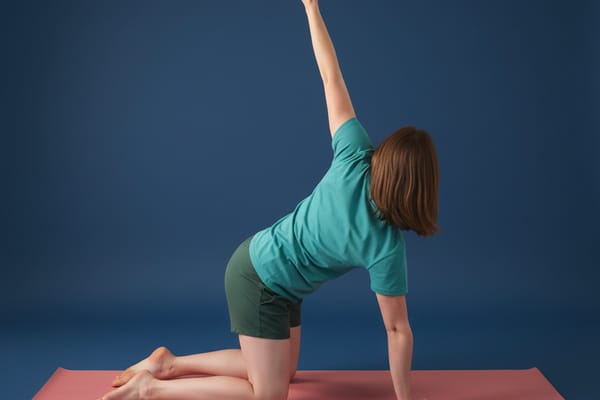
How to do it:
- Start on hands and knees
- Reach your right arm under your body toward the left side
- Lower your right shoulder and temple to the floor
- Keep your left arm planted or reach it overhead for added stretch
- Hold for 30-45 seconds each side
Adjustments: If reaching the floor is not possible, place a pillow or block under your head. For a deeper stretch, press your supporting hand into the floor and actively rotate further.
Child’s Pose with Side Reach
Standard child’s pose stretches the lats and lower back, but adding a lateral reach targets the thoracic spine and intercostal muscles.
How to do it:
- Kneel and sit back onto your heels
- Walk your hands forward into child’s pose
- Walk both hands to the right, creating a C-curve through the left side of your body
- Hold for 30 seconds, then walk to the other side
- Repeat 2-3 times each direction

Open Book (Thoracic Rotation)
A highly effective stretch for improving thoracic rotation while keeping the lumbar spine stable.
How to do it:
- Lie on your side with knees bent to 90 degrees and stacked
- Extend both arms in front of you, palms together
- Keep your knees stacked and slowly rotate your top arm over to the other side
- Follow your hand with your eyes
- Allow your upper back to rotate while keeping your pelvis stable
- Hold the open position for 5 seconds, return slowly
- Perform 8-10 repetitions each side
Thoracic Extension Over Foam Roller
If you have a foam roller, this is the most direct way to improve thoracic extension.
How to do it:
- Place a foam roller perpendicular to your spine at mid-back level
- Support your head with interlaced fingers behind your neck
- Slowly extend back over the roller
- Hold 5 seconds, then return to neutral
- Move the roller slightly higher or lower and repeat
- Work through 4-5 positions along the thoracic spine
Important: Keep the movement in the upper back. Your lower back should not arch excessively. Engaging your core lightly helps isolate the thoracic spine.
Eagle Arms

This stretch targets the space between the shoulder blades (rhomboids and mid-trapezius) and the posterior shoulder.
How to do it:
- Extend both arms forward
- Cross your right arm under your left at the elbows
- Bend both elbows and try to bring your palms together (or the backs of your hands)
- Lift your elbows to shoulder height
- Push your forearms slightly away from your face
- Hold for 30-45 seconds, then switch arm positions
Doorway Pec Stretch
While this primarily targets the chest, it directly addresses the muscle tightness that pulls the upper back into flexion.
How to do it:
- Stand in a doorway with forearms on the frame, elbows at shoulder height
- Step one foot forward through the doorway
- Lean forward until you feel a stretch across the chest
- Hold for 30-45 seconds
Variation: Adjust elbow height to target different portions of the pectorals. Elbows below shoulders targets the upper fibers; above shoulders targets the lower fibers.
Puppy Pose
A yoga position that creates deep thoracic extension while keeping the hips above the knees.

How to do it:
- Start on hands and knees
- Walk your hands forward while keeping hips directly above knees
- Lower your chest toward the floor
- Rest your forehead on the floor if possible
- Actively press your chest down to increase the stretch
- Hold for 45-60 seconds
Building an Upper Back Stretching Routine
Quick Desk Break (3 minutes)
Perform every 1-2 hours during desk work:
- Eagle Arms: 30 seconds each side
- Seated Twist: 20 seconds each side (grab opposite knee and rotate)
- Overhead Reach with Side Bend: 20 seconds each side
Daily Mobility Routine (8 minutes)
For maintaining and improving thoracic mobility:
- Cat-Cow: 10 cycles
- Thread the Needle: 30 seconds each side
- Open Book: 8 reps each side
- Child’s Pose with Side Reach: 30 seconds each side
- Doorway Pec Stretch: 30 seconds
- Eagle Arms: 30 seconds each side
Our Posture Reset Stretches routine offers a guided version of a similar sequence.
Comprehensive Session (15 minutes)
For addressing established stiffness or complementing strength training:
- Cat-Cow: 15 cycles
- Thread the Needle: 45 seconds each side
- Open Book: 10 reps each side
- Thoracic Extension Over Foam Roller: 5 positions, 10 seconds each
- Puppy Pose: 60 seconds
- Child’s Pose with Side Reach: 30 seconds each side
- Doorway Pec Stretch: 45 seconds
- Eagle Arms: 45 seconds each side
For guided sessions, try our Upper Body Flexibility Starter or Upper Body Flexibility Builder routines.
How Long Until You See Improvement
Thoracic mobility responds relatively quickly to consistent work. A study on thoracic stretching found that even short-term intervention reduced thoracic kyphosis angles and decreased upper back pain sensitivity.5 Most people notice meaningful improvements in posture and reduced stiffness within 2-3 weeks of daily practice.
A 6-week program of corrective exercises targeting thoracic hyperkyphosis produced significant improvements in kyphosis angle, shoulder position, chest expansion, and quality of life.6 So while you will feel better quickly, the deeper structural and postural changes develop over 4-8 weeks.
Beyond Stretching: Strengthening the Upper Back
Stretching alone addresses tightness but does not build the muscular endurance needed to maintain good posture throughout the day. Complement your stretching with:
- Band pull-aparts: 3 sets of 15-20 reps
- Face pulls: 3 sets of 12-15 reps
- Prone Y-T-W raises: 2 sets of 8 each position
- Wall slides: 3 sets of 10 reps
These exercises strengthen the lower trapezius, rhomboids, and posterior shoulder muscles that hold the thoracic spine in an extended position.
When to See a Professional
Consult a physical therapist or doctor if you experience:
- Sharp or burning pain between the shoulder blades that does not improve with gentle stretching
- Radiating pain into the arms or chest
- Numbness or tingling in the hands or arms
- Difficulty breathing combined with upper back pain
- Pain that worsens at night or is unrelated to position
Upper back pain is usually musculoskeletal, but chest-area symptoms warrant medical evaluation to rule out other causes.
Key Takeaways
- Thoracic stiffness affects more than your back: Restricted thoracic mobility impairs shoulder function, breathing, and overall posture
- Desk work is the primary driver: Sustained flexion during sitting progressively stiffens the upper back over months and years
- Rotation goes first: Thoracic rotation is typically the first movement lost, making thread the needle and open book especially valuable
- Shoulders depend on your upper back: Research shows that shoulder range of motion is significantly greater when thoracic posture is upright
- Results come quickly: Noticeable improvements in 2-3 weeks with daily practice, significant postural changes within 6 weeks
- Strengthen alongside stretching: Stretching restores mobility, but strengthening maintains it throughout the day
Related Articles
- Back Stretches: Exercises for Upper, Mid, and Lower Back
- Posture Exercises: Fix Rounded Shoulders and Forward Head
- Shoulder Mobility Guide
- Tech Neck: Causes, Symptoms, and Stretches That Actually Help
- Stretching for Desk Workers: The Complete Daily Plan
- Neck Pain and Stretching: The Complete Evidence-Based Guide
- Chest Stretches: How to Open Up Tight Pecs
References
Rabal-Pelay J, Cimarras-Otal C, Berzosa C, et al. (2020). Spinal sagittal alignment, spinal shrinkage and back pain changes in office workers during a workday. International Journal of Occupational Safety and Ergonomics, 28(1), 1-7. PubMed ↩︎ ↩︎
Sepehri S, Sheikhhoseini R, Piri H, Sayyadi P. (2024). The effect of various therapeutic exercises on forward head posture, rounded shoulder, and hyperkyphosis among people with upper crossed syndrome: a systematic review and meta-analysis. BMC Musculoskeletal Disorders, 25(1), 105. PubMed ↩︎
Hunter DJ, Rivett DA, McKeirnan S, Smith L, Snodgrass SJ. (2020). Relationship between shoulder impingement syndrome and thoracic posture. Physical Therapy, 100(4), 677-686. PubMed ↩︎
Barrett E, O’Keeffe M, O’Sullivan K, Lewis J, McCreesh K. (2016). Is thoracic spine posture associated with shoulder pain, range of motion and function? A systematic review. Manual Therapy, 26, 38-46. PubMed ↩︎
Yoo WG. (2013). Effect of thoracic stretching, thoracic extension exercise and exercises for cervical and scapular posture on thoracic kyphosis angle and upper thoracic pain. Journal of Physical Therapy Science, 25(11), 1509-1510. PubMed ↩︎
Eftekhari E, Sheikhhoseini R, Salahzadeh Z, Dadfar M. (2024). Effects of telerehabilitation-based respiratory and corrective exercises among the elderly with thoracic hyper-kyphosis: a clinical trial. BMC Geriatrics, 24(1), 234. PubMed ↩︎
