

About This Hip Support Routine
Your hips control what happens at your knees. When your glutes are weak or your hip rotators are tight, your femur rotates inward and your knee follows — leading to the inward collapse that causes so many knee problems. This routine addresses the hip muscles that directly influence knee alignment.
Hip circles warm the joint. Butterfly opens your adductors and inner hips. Lying figure-four targets the piriformis and external rotators that control femoral rotation. Happy baby stretches the hips passively. Single-leg stand builds the balance and hip stability that keeps your knee tracking straight. Bridge activates the glutes that are the primary controllers of hip and knee alignment.
The connection between hip weakness and knee pain is well-established. Strengthening and stretching the right hip muscles is often more effective for knee relief than treating the knee itself.
What This Routine Targets
- Hip rotator flexibility and glute activation
- Adductor length and inner hip mobility
- Single-leg balance and stability
- Knee alignment through hip control
What’s Included
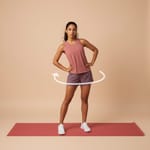
Hip Circles
Duration: 0:30
Draw smooth circles with your hips to mobilize the pelvis and lower back before deeper work.
Difficulty: Beginner
Instructions
- Stand with feet hip-width apart and hands resting on your hips.
- Slowly rotate your hips in a circular motion, tracing a wide circle in one direction.
- After several reps, switch directions to balance the movement.
Tips
- Keep your core engaged to support the lower back.
- Maintain soft knees rather than locking them out.
Adjustments
- Shrink the circle if your range of motion feels limited today.
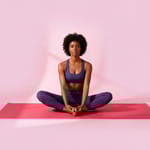
Butterfly
Duration: 0:45
Drop into butterfly pose to open the hips and groin while you breathe space into tight muscles.
Difficulty: Beginner
Instructions
- Sit tall with legs extended, then bend your knees and bring the soles of your feet together.
- Hold your feet or ankles and let your knees fall out to the sides.
- Press the knees gently toward the floor while keeping the spine long.
Tips
- Use your elbows to nudge the thighs downward only if it feels comfortable.
- Lift through the chest and avoid rounding your back.
Adjustments
- Place cushions under your thighs when the hips need extra support.
- Sit on a folded blanket to elevate your seat and create more ease.
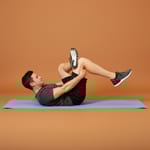
Lying Figure Four
Duration: 1:00
Ease into a lying figure four to release tight glutes and soothe your lower back.
Difficulty: Beginner
Instructions
- Lie on your back with knees bent and feet flat on the floor.
- Cross one ankle over the opposite thigh just above the knee.
- Lift the bottom leg and clasp hands behind the thigh, gently pulling the legs toward your chest.
Tips
- Relax your head and shoulders on the floor.
- Keep your lower back pressing gently into the mat.
Adjustments
- Loop a strap behind your thigh if reach is an issue.
- Leave the bottom foot on the floor for a lighter stretch.
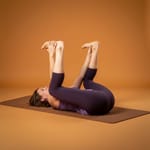
Happy Baby
Duration: 0:45
Rock into happy baby to soothe your lower back and open your hips with a playful stretch.
Difficulty: Beginner
Instructions
- Lie on your back with knees bent and feet flat.
- Lift your feet and draw knees toward your armpits.
- Grab the outer edges of your feet and gently pull your knees toward the floor while keeping your low back grounded.
Tips
- Press your tailbone toward the floor to keep the lower back happy.
- Relax your shoulders and jaw while you breathe.
Adjustments
- Hold your ankles or calves if reaching your feet is a stretch today.
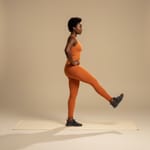
Single Leg Stand
Duration: 0:30
Test your balance by standing on one leg with calm, focused strength.
Difficulty: Beginner
Instructions
- Stand with feet hip-width apart and hands on your hips.
- Engage your core, lift one foot off the floor, and extend it slightly in front of you.
- Balance on the standing leg and hold while breathing steadily.
Tips
- Keep a soft bend in the standing knee to stay stable.
Adjustments
- Lightly touch a wall or chair for support if needed.
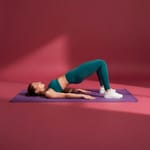
Bridge
Duration: 0:45
Lift into a grounded bridge to awaken glutes and hamstrings while giving your spine a friendly stretch.
Difficulty: Beginner
Instructions
- Lie on your back with knees bent, feet hip-width, and arms relaxed by your sides.
- Press through both heels to raise your hips, creating a straight line from knees to shoulders.
- Hold the lift with glutes fired up and breathe into your ribs before lowering with control.
Tips
- Squeeze the glutes at the top so the work stays in the backside instead of the low back.
- Keep ribs down and core engaged to prevent excessive arching.
Adjustments
- Lift the hips to a halfway point if you want a lighter option.
- Rest your head on a folded towel when the neck needs extra support.
Who Should Try This
People whose knees collapse inward during squats or stairs, runners with IT band issues, and anyone who’s been told their knee problems stem from hip weakness. If you’ve been stretching your quads and hamstrings without relief, weak hips might be the missing piece.
Tips for Best Results
- During single-leg stand, focus on keeping your pelvis level — don’t let your hip drop
- In bridge, squeeze your glutes hard at the top and keep your knees from drifting apart
- During butterfly, sit tall and let gravity pull your knees toward the floor
- Pay attention to side-to-side differences; your tighter side needs more work
The Hip-Knee Connection
When your hips are strong and mobile, they absorb forces that would otherwise land on your knees. Every hip exercise in this routine has a direct line to better knee function. Address the hips, and the knees often take care of themselves.


