

About This Core Support Routine
Your core is not just your abs. It is the entire cylinder of muscles wrapping around your midsection, and it is the foundation your posture is built on. When your core is weak, your spine compensates. Your lower back overworks, your shoulders round, and your whole alignment shifts.
This routine trains the core muscles that matter most for posture. Dead bugs teach your abs to stabilize while your limbs move. Planks build endurance in the deep stabilizers. Bird-dog challenges your core to resist rotation. Bridges activate the glutes that support your pelvis. Pelvic tilts and cat-cow round things out with mobility work that keeps your core responsive.
What This Routine Targets
- Deep core stabilizers with planks and dead bugs
- Anti-rotation strength through bird-dog
- Glute and pelvic floor support with bridges and pelvic tilts
- Spine-core coordination with cat-cow
What’s Included
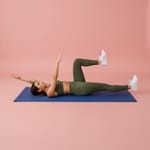
Dead Bug
Duration: 0:45
Stabilize your core with controlled dead bug holds that challenge coordination and focus.
Difficulty: Beginner
Instructions
- Lie on your back with arms reaching toward the ceiling and legs extended.
- Brace your core, lift one knee above the hip, and raise the opposite arm toward the ceiling.
- Hover the other arm and leg just off the floor and hold the position with steady breathing.
- Switch sides halfway through the set with the same control.
Tips
- Press your lower back into the mat to keep your spine safe.
- Keep hips square and avoid letting one side drop toward the floor.
Adjustments
- Work through a smaller range of motion if needed, lifting limbs only partway.
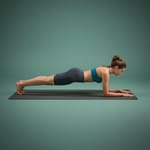
Elbow Plank
Duration: 0:30
Hold a solid forearm plank to build core strength and full-body tension from shoulders to toes.
Difficulty: Beginner
Instructions
- Start on all fours, then lower forearms to the floor and step both feet back.
- Engage your core to create a straight line from head to heels.
- Distribute weight evenly between forearms and feet and hold with steady breathing.
Tips
- Stack elbows under shoulders for stability.
- Avoid letting your hips sag or lift too high.
Adjustments
- Drop to your knees while keeping a straight line from knees to head if you want a lighter option.
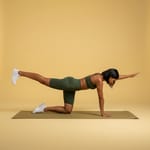
Bird Dog
Duration: 1:00
Pair opposite arm and leg reaches to build a rock-solid core and graceful balance.
Difficulty: Beginner
Instructions
- Set up on all fours with shoulders stacked over wrists and hips over knees.
- Brace your core, then extend one arm forward while the opposite leg reaches straight back.
- Hold the long line parallel to the floor and breathe steadily before returning to tabletop.
- Alternate sides with the same calm control.
Tips
- Keep your hips level by pressing the supporting hand and knee firmly into the floor.
- Think about length from fingertips through the heel rather than height.
Adjustments
- Practice lifting just the arm or just the leg until the full variation feels steady.
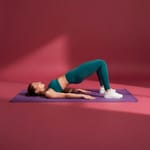
Bridge
Duration: 0:45
Lift into a grounded bridge to awaken glutes and hamstrings while giving your spine a friendly stretch.
Difficulty: Beginner
Instructions
- Lie on your back with knees bent, feet hip-width, and arms relaxed by your sides.
- Press through both heels to raise your hips, creating a straight line from knees to shoulders.
- Hold the lift with glutes fired up and breathe into your ribs before lowering with control.
Tips
- Squeeze the glutes at the top so the work stays in the backside instead of the low back.
- Keep ribs down and core engaged to prevent excessive arching.
Adjustments
- Lift the hips to a halfway point if you want a lighter option.
- Rest your head on a folded towel when the neck needs extra support.
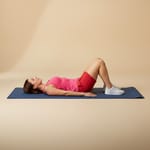
Pelvic Tilt Press
Duration: 0:30
Use a gentle pelvic tilt to teach your lower back how to relax and your core how to engage.
Difficulty: Beginner
Instructions
- Lie on your back with knees bent and feet flat on the floor.
- Engage your core to tilt your pelvis upward and press your lower back into the mat.
- Keep arms relaxed by your sides and hold the position for a breath before releasing.
Tips
- Draw your navel toward your spine to initiate the movement.
- Let your glutes stay soft so the action comes from your core.
Adjustments
- Perform the same motion standing with your back against a wall if the floor feels uncomfortable.
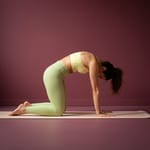
Cat Cow
Duration: 0:30
Flow through cat and cow to mobilize your spine and melt away stiffness one breath at a time.
Difficulty: Beginner
Instructions
- Begin on hands and knees with wrists under shoulders and knees under hips.
- Inhale as you drop your belly, lift your chest, and gaze forward or slightly up.
- Exhale as you round your spine, draw the belly toward the ceiling, and tuck your chin.
- Continue gliding between the two shapes in rhythm with your breath.
Tips
- Move slowly enough that each vertebra gets a moment of attention.
Adjustments
- Keep your head more neutral if your neck prefers less movement.
Who Should Try This
Anyone whose posture collapses when they get tired, especially in the lower back. If you notice your belly pushing forward or your lower back arching excessively by the end of the day, weak core stabilizers are likely the cause.
Tips for Best Results
- During dead bugs, press your lower back into the floor throughout the entire movement. If it arches up, you have gone too far with your limbs.
- Planks should be held with a slight posterior pelvic tilt. Think about tucking your belt buckle toward your chin.
- In bird-dog, move slowly enough that your hips stay completely level. Place a water bottle on your lower back to test yourself.
- Do this routine on the same days as back strength for a complete support system.
Support from the Inside
Good posture is an inside job. The muscles you can see in the mirror are less important than the stabilizers you cannot see. This routine trains those hidden muscles to hold your spine in place so your posture works on autopilot.


